Sunday, December 1, 2019

1st Sunday of Advent @ St. Vincent de Paul

HOMILY - FIRST SUNDAY OF ADVENT
NOVEMBER 30 / DECEMBER 1, 2019
4:30 PM (SAT), 9:00 AM (SUN) ORDINARY FORM MASSES


At the University of Colorado (Boulder), Dr. Kenneth P. Wright heads up the “Sleep and Chronobiology Laboratory” which does research in the psychological and physiological issues surrounding sleep and wakefulness.

One of his areas of research is in what is called ‘Sleep Inertia’ - which is outlined in an article titled: “Waking Up is Hard to Do.”


According to research, during the first three minutes after waking up, a person can exhibit severe cognitive impairment - such as poor memory, slowed speech, impaired decision making and performance issues.

In the first ten minutes, some may continue to have difficulty speaking clearly or show difficulty in counting.

And over the next two hours – which, of course can vary from person-to- person – an individual may continue to show certain performance problems.


When a person wakes up, their heart rate increases; their breathing becomes more rapid and deeper; circulation and blood flow increase; the brain is flooded with various hormones and chemicals; and every organ in the body shifts into a more active (or waking) mode.

Today is the First Sunday of Advent.


In the First Reading and Psalm Response we hear the admonition to “Come up” and to “go up” to the House of the Lord ... on the Mountain of the Lord of Hosts. There is talk of “peace” on various levels - between nations, within the walls of the city, and within each person.

And in the Second Reading and the Gospel we hear the call to “wake up.”

The season of Advent is one of two penitential seasons the Church gives us to “fix up” our relationship with God and Jesus Christ.

Jesus tells us that up to the moment of the flood, everybody was on autopilot ... doing what they had always done. Everyone, except Noah and his family.


 If we desire to make spiritual progress during this new liturgical year, it certainly behooves us to “wake up” to what is going on around us. To turn off the autopilot, and to take an assessment of our relationship to the Almighty ... Father, Son, and Holy Spirit.

And similar to waking up bodily, when we “wake up” spiritually ... it will affect every aspect of who we are ... engaging us ... body, mind, soul, and spirit.


St. Paul expands on this ... going beyond the call to “wake up” and admonishes his readers - and us as well - to “clean up” and in a certain sense to “grow up.”

We are to “clean up” by putting away any “works of darkness”, and “put[ting] on the armor of light.” We are to “grow up” by “conduct[ing] ourselves properly as in the day” and “put[ting] on the Lord Jesus Christ”.

As we begin our new liturgical year ... entering into this holy Season of Advent ... “let us go rejoicing to the house of the Lord” ... “that he may instruct us in his ways, and we may walk in his paths” so that we might receive His peace ... the peace that the world cannot give.


And as we approach this altar to receive the Sacred Body and Blood, Soul and Divinity of Jesus Christ ... let us pray for the graces we need to “wake up” despite the slumber of the world around us. Let us cast off whatever spiritual inertia is holding us back from a fuller relationship to Jesus and to His Father. Let us “walk in the light of the Lord” ... putting on Christ ... and living in the light ... As we move forward into a new Church year and prepare to welcome Christ anew in His Nativity.

Sunday, November 24, 2019

Christ the King @ St. Vincent de Paul

HOMILY - SOLEMNITY OF CHRIST THE KING OF THE UNIVERSE
NOVEMBER 24, 2019
7:30 AM, 10:30 AM (SUN) ORDINARY FORM MASSES


The fourth century BC philosopher Aristotle is known as the Father of Western Philosophy. Among his many writings are six works specifically on Logic (known as the Ὄργανον – or “Instrument”). One of these six works is titled  Κατηγορίαι or The Categories.

The Categories is his singularly important work in that it not only presents the backbone of his theorizing, but also had a major influence on western philosophy from that point on. Aristotle enumerates the variety of things that can be spoken of, as well as what can be said of those things.


More specifically, he lays forth ten categories: (1) substance; (2) quantity; (3) quality; (4) relation; (5) location; (6) time; (7) position; (8) having; (9) acting; and (10) receiving.

In the Categories, according to Aristotle, every object of human apprehension can be described using these ten categories.


Today is the Solemnity of Our Lord Jesus Christ, King of the Universe.

If we were to immediately apply human categories on the term “King,” we would perhaps consider the terms “figurehead” or maybe “tyrant.” Human kings, indeed fall short in many areas. And in our own day and age, leadership – even in elected republics – is sorely lacking.

In the first reading from Second Samuel, we hear of King David. He was anointed king twenty years before – as a mere boy. Considered so insignificant that the prophet had to keep asking his father Jesse if he had another son. Yet now, two decades later, he is King of Judah; and the remaining eleven tribes come to him, asking him to be their king as well.


They call him “[our] bone and [our] flesh” – terms not only of relation, but also words used in covenant making in the ancient world. They also recall the word of the Lord God spoken by the prophet,
You shall shepherd my people Israeland shall be commander of Israel.
And the word translated here as “agreement” is the Hebrew word בְּרִית (bᵉrîyth) – which is indeed a covenant – more than just an agreement, but rather it is a joining of persons and uniting of families.

In the Letter to the Colossians, St. Paul lays out Jesus’ qualifications. Even in the first century, many people gave Jesus lip-service, but failed to give Him pre-eminence. They sought to de-throne Him and considered Him just one of many spiritual guides.


St. Paul emphasizies that Jesus is (1) the Savior Who (a) rescues His people, (b) leads them into His kingdom, and (c) pays our debt – ultimately freeing us from sin and death.

He goes on saying that Jesus is (2) the Creator Who (a) existed before all creation, (b) created all things, and that (c) all things exist for Him – as we pray in this liturgy, “through Him, with Him, and in Him.”

Finally, Paul tells us that Jesus is the Head of the Church – meaning more than just “leader” or “ruler” but also “source,” “origin,” and “beginning.”


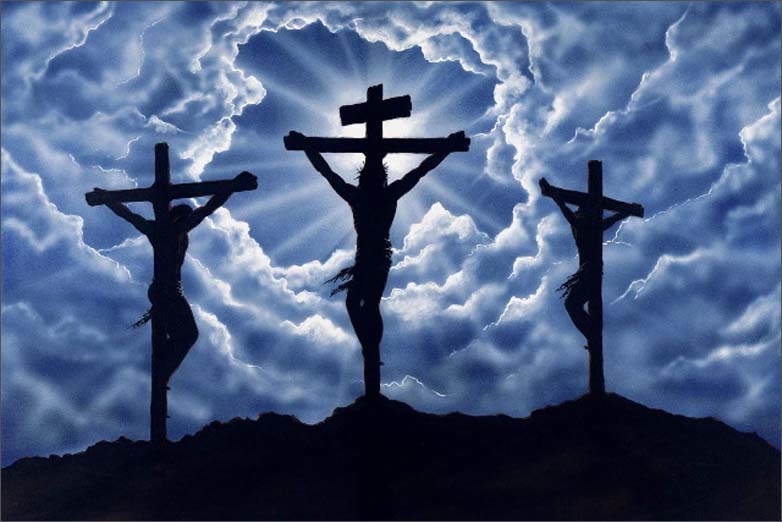
Finally, in the crucifixion scene from Luke’s Gospel, above His head is the inscription, “This is the King of the Jews.”

Jesus reigns from the Cross … the Cross is His throne, and in his interaction with the Good Thief (a unique feature of Luke’s Gospel) Jesus holds court from this unlikely throne – passing judgment, and granting pardon to the Penitent Thief.


The rulers, the soldiers, and the other thief see only the earthly categories: a convicted criminal, found guilty and executed through a slow, cruel, and painful torture and eventual death. While what was actually before their eyes was the Son of God, reigning from the Cross, and conquering sin and death. All through the power of Divine, self-sacrificing, agape (ἀγάπη) love.

As we approach this altar to receive the Sacred Body and Blood, Soul and Divinity of Jesus Christ – let us look upon the scene that holds the central place on the reredos of the high altar. Let us gaze upon it – not with human eyes and earthly categories – but rather with the eyes of Faith. And see our divine and heavenly King ... reigning eternally and conquering sin and death – and in that moment renew our covenants of love with Him, as we receive Him in the Most Holy Eucharist.

Saturday, November 16, 2019

33rd Sunday in OT @ St. Vincent de Paul

HOMILY - 33RD SUNDAY IN ORDINARY TIME
NOVEMBER 16/17, 2019
5:00 PM (SAT), 9:00 AM (SUN) ORDINARY FORM MASSES


According to a geneticist at UC San Diego who is researching DNA methylation in mammals, if you want to know how old your dog is in people years, multiply the natural logarithm of their age by 16 and add 31. This is based on an analysis of over 100 Labrador Retrievers and comparing the similarities of gene methylation between both species.

I always considered that a “dog year” was seven people years. That has somewhat less scientific support – apparently arising from a 1970s Alpo dog food commercial featuring Lorne Green, who introduced his dog and told all of America that “Duchess is 13. That’s like 91 to you and me.”


WebMD claims the first year of a dog’s life is roughly 15 years, the second 9, and the remaining years varying between 3 and 5 human years.

An 13th century inscription surrounding the Cosmati pavement in front of the high altar at Westminster Cathedral sets the number of dog years at 9, and lays out the ages of various creatures in various powers of 3. Based on the inscription, humans live to 81, whales live over 6,500 years, and the world itself will end after just less than 20,000 years.


Today is the 33rd Sunday in Ordinary Time.

Our readings have been taking on an eschatological theme over the past several weeks. Eschatology being the theological study of the end of things – coming from the Greek word ἔσχατον meaning “the end” or “the last.”


Our first reading comes from the last chapter of the Book of Malachi – who just happens to be the last of the Old Testament prophets. The overarching theme in this book is how should the people of Israel live a godly life? And Malachi goes at it from several angles, enumerating all the different ways that the people have gotten it all wrong.

St. Paul, in the second reading from the Second Letter to the Thessalonians tells them – and us – to simply follow his example; so that we might be ready when the “Day of the Lord” – that is the Second Coming of Christ – arrives … whether in our own lifetime, or at some other time in the future.


The Gospel reading we heard from St. Luke is the last chapter before the Last Supper and Our Lord’s Passion, Death and Resurrection. It concerns what is often called the “Tribulation” – what will occur before the end of time when “God's triumph over the revolt of evil will take the form of the Last Judgment after the final cosmic upheaval of this passing world.” (CCC 677)

Despite the excitement of the discourse, when all is said and done, Jesus admonishes us to persevere in order to save ourselves.

And so, here we are in the waning days of November, where the Church puts forward for our consideration the “Last Things.”


Since about the 16th century, the “Four Last Things” have meant Death, Judgment, Heaven, and Hell. And there are countless books and writings by saints and others on these. (There is also a point and click video game on the Four Last Things, if you're interested in medieval art and music.)

So, what are we to do?

Reflecting on today’s readings, it would seem that the best way to prepare for the end … the ἔσχατον … the last things … is to live a godly life, in accord with the teachings and traditions of the Church and the Apostles – to follow Christ; and to persevere.

In other words, a good end comes about through a good life … and a godly life leads to a godly end.


As we approach this altar to receive the Sacred Body and Blood, Soul and Divinity of Jesus Christ; let us pray for the grace of perseverance – and even more so, the grace of final perseverance. So that we might live … through, with, and in Christ … and reign with Him for eternity.

Saturday, November 2, 2019

31st Sunday in OT @ St. Vincent de Paul

HOMILY - 31ST SUNDAY IN ORDINARY TIME
NOVEMBER 2/3, 2019
5:00 PM (SAT), 9:00 AM (SUN) ORDINARY FORM MASSES


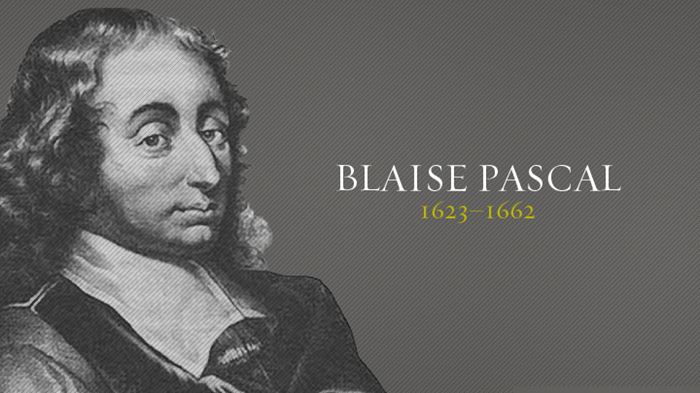
Born in the south central French alps in the early 17th century, French scientist and philosopher Blaise Pascal was the son of a tax collector and a child prodigy. He designed and built mechanical calculators and wrote on fluid mechanics, projective geometry, and probability theory.

After his death, his philosophical and theological notes were published, titled Pensées – or Thoughts. Within this work is a philosophical argument – referred to as Pascal’s Wager – the gist of which is that an individual bets their whole life on the premise of whether or not God exists.


Pascal argues that a reasonable person should live as if God exists and foster a faith in God – since, if God does not exist one only stands to lose only limited or finite things … whereas if God does exist there are infinite and eternal gains to be had – namely Heaven … or infinite and eternal losses – namely Hell.

Today is the 31st Sunday in Ordinary Time.

In todays reading from the Gospel of Luke, we hear the story of the chief tax collector Zacchaeus – who in his small efforts to see Jesus realizes that Jesus is looking for him as well.


His meeting with Christ – and subsequent repentance and conversion – turns the grumblings of the naysayers on their ears, and Our Lord proclaims:
Today salvation has come to this house …For the Son of Man has come to seeknd to save what was lost.
We hear in the first reading from the Book of Wisdom about God’s mercy and love – and how even the smallest details are willed by God – and how it is within His Will that all souls repent and believe in God.

St. Paul, in the excerpt from the beginning of the Second Letter to the Thessalonians speaks of remaining steadfast in our Baptismal call and to be firm in our Faith; and not become easily unsettled by random musings.


For ourselves, we can too often limit our perception of God and His goodness. Presuming that we can hide from God’s sight, or that God’s love is limited to other people or other things. Yet in both of these, we can fail to realize that nothing goes unnoticed by God and that He is actively seeking us out … seeking every single person … in order to bring them into His glory.

God’s mercy does not negate His justice ... and we must make an active respond to God’s mercy and love.


When we pray the Our Father, our pledge that His will be done – implies that the desire to conform our wills to God’s Will … and not the other way around.

As we approach this altar to receive the Sacred Body and Blood, Soul and Divinity of Jesus Christ – let us repent of anything holding us back from being completely and totally committed to God … and in return may we receive the fullness of His grace, His mercy, and His love through the outpouring of the Holy Spirit in our life.

Saturday, October 19, 2019

29th Sunday OT @ St. Vincent de Paul

HOMILY - 29TH SUNDAY IN ORDINARY TIME
OCTOBER 19/20, 2019
5:00 PM (SAT), 9:00 AM (SUN) 5:00 PM (NEWMAN CTR) ORDINARY FORM MASSES


The Aesopica is a collection of fables credited to the Greek storyteller Aesop, who lived around the sixth century before Christ. There are over 700 fables, and one of perhaps the best known is The Tortoise and the Hare.

Interestingly, because it was never translated into Latin, it remained relatively obscure until the 16th century when it was translated into French and Dutch. Not until 100 years later is it found in English.


Walt Disney provided an animated version of the fable in 1935, where the hare is a smart aleck college boy, complete with varsity sweater and adoring bunnies swooning over him. The tortoise is an honest working man, who just keeps on keeping on.

The hare, bathed in his own self-confidence, takes a nap. And when all is said and done, the Tortoise is the winner.


In our own time, the moral of the story is: “Slow and steady wins the race.” While in its own time, the moral may have been more based on attitude – the hare’s foolish overconfidence leads to his demise against an easy target. An ancient Greek source points out that those with positive natural abilities often ruin them by idleness. Emphasizing that sobriety, zeal, and perseverance can overcome laziness – regardless of ability.

By the 17th century, the moral was “perseverance winneth,” while religious commentators have leaned toward Ecclesiastes 9:11 – “the race is not to the swift,” while another notes that “the more haste, the worse speed.”


Today is the 29th Sunday in Ordinary Time. And our readings point to “perseverance.”

In Exodus we hear of Moses’s perseverance in prayer – even to the point of having Aaron and Hur get him a chair and hold up his hands. And how this led to Israel’s victory in one of its first battles in the desert.

St. Paul admonishes Timothy to be “faithful to what you have learned and believed” and to be persistent.


The words translated as “faithful” and “persistent” are, in the Greek, μένω and ἐφίστημι. The first is where we get the English word remain. The second implies readiness. In some sense like a soldier on station, ever watchful.

What is translated here as “convenient or inconvenient” has more often been translated as “in season or out of season.” The root word here being καιρός which means an opportune time – as in the beginning of St. Mark’s Gospel is translated “the time of fulfillment.”


The point of the Gospel is given away in the first sentence. St. Luke tells us that the parable is about “the necessity …to pray always without becoming weary.”

The two enemies of perseverance are apathy and over-confidence.


What I would call “meh” and “me.”

We can be so self-assured that we step into presumption – and in losing sight of the goal, miss out completely. Or, we can give up before we’ve ever started, and never know if we have a chance.

The key is to strike a balance – what Aristotle called “The Golden Mean.” To know oneself – but  within the boundaries of humility, while knowing what must be done – and doing it.


As we approach this altar to receive the Sacred Body and Blood, Soul and Divinity of Jesus Christ, let us pray for the grace to persevere.

And as we move closer to November, the month of the Holy Souls, let us also pray for the grace of final perseverance. To follow Christ – unreservedly to the end – so that in faithfully following Him here on earth, we might follow Him into glory in eternity.

Saturday, October 12, 2019

28th Sunday in OT @ St. Vincent de Paul & St Joseph

HOMILY - 28TH SUNDAY IN ORDINARY TIME
OCTOBER 12/13, 2019
5:00 PM (SAT @ COTATI), 7:30 AM, 10:30 AM (SUN) ORDINARY FORM MASSES


Aurelius Prudentius Clemens was a Roman Christian poet born in 348 in northern Spain.

He was a lawyer, and provincial governor; eventually ending up in the Imperial Court of Emperor Theodosius I (the first). Around the age of 50, he left public life and devoted his time to fasting, prayer, and writing.

Prudentius's allegorical poem titled Psychomachia – in English, The War for the Soul – was his most influential work. Focusing on the spiritual battle, it captured the imagination of Christians in the middle ages; being illustrated in manuscripts and on church walls – as a sort of medieval comic book. And continues to captivate and interest well into modern times – as a strategy card game.


In this epic poem, the seven virtues are portrayed as seven heroic women who go to battle against the vices, portrayed as seven haughty and wicked women.

Faith beheads Idolatry, Chastity slays Lust with a sword to the throat, and Sobriety uses a cross to sabotage Greed’s chariot before crushing her with a stone. Patience exhausts Anger, who then dies by her own sword.


And on and on, Humility, Hope, and Concord all take to the battlefield being cheered on by saints and biblical figures – and conquer all the other vices.

It really makes for a great comic book. Sort of seven “Wonder Women” facing their arch-nemeses, all in Latin verse and sometimes with pictures.


Today is the 28th Sunday in Ordinary Time.

Our readings today give us a look into biblical and Christian virtues.


Namaan the Syrian general is looking for a cure for his leprosy. Yet if we read the story that precedes today’s reading, we learn that Namaan needed to get over his pride, his anger, and his self-will. In the end, as we heard today, he was healed. But in both body and soul.

St. Paul speaks of virtues and vices as well. Perseverance, Honesty, Transparency, and Fidelity. Pointing out that our Christian walk requires an inward transformation – so that we might be always, more and more, conformed to the image of Jesus Christ.


In the Gospel, Our Lord shows Generosity to ten lepers. They are all healed through Obedience to His command. Yet only one returns to show Gratitude, glorifying God and giving thanks to Jesus.

While there are various arrangements and listings of virtues and vices the etymologies of these words are quite simply that virtues are strengths and vices are weaknesses.


As we approach this altar to receive the Sacred Body and Blood, Soul and Divinity of Jesus Christ, let us pray that we might allow the grace of God to transform us interiorly. To cast of the sins of our past, and the vices of the world. To hear and listen to God’s call and to fight the spiritual battle, every day – in the power of the Holy Spirit, and in the strength of Christ Jesus – growing in both virtue and holiness, so we might truly live as the adopted children of God the Father, both now and in eternity.

Wednesday, October 2, 2019

Confirmation Talk to Parents @ St. Vincent de Paul

CONFIRMATION TALK TO PARENTS
OCTOBER 2, 2019
7:00 PM (WED) IN THE PARISH HALL

Handout (English)


Folleto (Español)