Monday, March 16, 2020

3rd Sunday of Lent @ St. Vincent de Paul

HOMILY - THIRD SUNDAY OF LENT
MARCH 15, 2020
7:30 AM AND 9:00AM ORDINARY FORM (ENGLISH) MASSES


According to a longstanding Christian tradition, Sacred Scripture can be interpreted in two particular ways. These two are called the literal and spiritual senses of Scripture.

Looking at our three readings today literally, we get that at some point during the 40 year Exodus in the desert, the people of Israel complained about not having water, Moses prayed, God answered, Moses struck a rock, and water came out of it.

The same can be said about the Gospel. Jesus took a shortcut through Samaria, met a woman, had a “he said, she said” conversation about religion, proceeded to exceed her expectations, and converted a whole Samaritan town; all while His disciples were out grocery shopping.

And finally, St. Paul wrote a letter.


The literal sense doesn’t always give us much to look at, and certainly doesn’t make for much of a homily.

The spiritual sense, however can be broken down further into three divisions.

(1) the allegorical - which are the signs that point to God – Father, Son, and Holy Spirit,
(2) the moral - which tell us how we should or should not act in our daily lives, and finally
(3) the anagogical - which are the signs that point us to eternity.

These are the interesting aspects of Scripture. Where the rubber hits the road. And where, if we dig a little deeper, we get spiritual treasure.

In the reading from Exodus, the Israelites are complaining that they don’t have any water. OK.

They’re in the desert, and they’re thirsty. Sounds logical.


But realize that they’ve already witnessed the Plagues in Egypt, crossed the Red Sea on dry land, seen God defeat the entire Egyptian army, and have been eating Manna and Quail that God sends them daily. Can anyone think of a better option besides complaining?

It’s not like they haven’t been on the receiving end of some pretty awesome miracles. But, nonetheless, here they go again. Maybe it’s just human nature to complain.

In his 1st Letter to the Corinthians, St. Paul points out a striking allegory: the crossing of the Red Sea foreshadowed Baptism, the Manna and Quail foreshadowed the Eucharist, and the Rock – which he tells us, not only poured forth water, but followed them around the desert – symbolized Christ and the outpouring of the Holy Spirit.


He goes even deeper into moral and anagogical senses, but you can look that up – if you want – it’s 1st Corinthians Chapter 10.

The real beauty in this week’s readings is the Gospel from St. John, Chapter 4: Jesus meets the Samaritan woman at the well. It’s long. Even the short version is long.


I’m sure that we all have some sort idea that the Jews and Samaritans were not friends. Jesus is called a Samaritan by the Scribes and Pharisees; and it’s not a compliment. Jesus, in turn, returns the favor with the Parable of the Good Samaritan – where the Priest and Levite walk right by their own countryman on the side of the road, leaving him there to die, but a Samaritan goes out of his way – and in fact, he goes WAY out of his way – to help not just a stranger, but an enemy.

The division between Jews and Samaritans springs out of what we might call religious purity. Way back, during those various conquests, occupations, and captivities of Israel, the Assyrians purposely settled the area of Samaria with five different pagan groups – each with their own language, customs, and religion. So, in the end, the Samaritans ended up with a syncretic – or a mish-mash religion involving not only the God of Israel, but also a melting pot of other pagan gods.

The Samaritans weren’t welcomed at the Temple in Jerusalem, and so they went and built their own. They edited down the Torah to a bare minimum of only the Five Books of Moses (the first five books of the Bible) purposely ignoring the histories and prophets which condemned what the Samaritans were doing.

So, with this background, we find ourselves in today’s Gospel, in the middle of town, in the middle of the day,  with Jesus, looking for a drink of water. So that’s the literal sense; but what about the spiritual sense? After all, St. John loves to hide spiritual signs and gems in his Gospel, and he doesn’t disappoint us here.

The five husbands – or as the word can also be translated, five “masters” – are the five pagan gods whom the Samaritans worshipped alongside the One True God – the God of Israel. Along the way they had picked up (1) a god of fertility, (2) a god of war, (3) a god of fate, (4) a god of storms and rain, and (5) a moon goddess. These they inherited from those 5 pagan groups the Assyrians moved there several hundred years before.

The one husband who was not her “master” – but whom she needed to take more seriously – and submit her life to – was God almighty … the God of Israel.

She gets it. And she tells Jesus that He must be a prophet – but we just heard that the Samaritans rejected the prophets. So, what is she talking about here? Well, the only prophet mentioned in the first five books of the Bible is the Messiah. And so she proclaims, just like St. Peter does in the other three Gospels, that Jesus is the Christ!

In one fell swoop, the hammer falls, and we get all three spiritual senses at one time. And this is how and where today’s Gospel story should speak directly to us.


Morally: we can have no other gods besides God Himself. Sex, power, luck, weather, time – these are all created things, not gods to be worshipped. God must come first.

Analogically: Jesus alone can save us, and we need to put all of our trust in Him – and in Him alone. For only Jesus Christ can give us the Living Water – the Holy Spirit – which in turn can transform us to truly be His disciples – configured to Him in all things.

And finally, anagogically: whatever walls and barriers that we may think divide us from others – those things that make us “us” and them “them” – are obstacles to our true worship of God – what Jesus calls “worshipping [God] in spirit and in truth.”

As we approach this altar to receive the Sacred Body and Blood, Soul and Divinity of Jesus Christ – let us pray to cast aside any created things that stand between us and God; let us cry out to Jesus, our Savior, to “save us”; and let us join together as one body, one Church – united in Christ, and filled with the Holy Spirit – to the praise and glory of God the Father.

Saturday, March 7, 2020

2nd Sunday of Lent @ St. Vincent de Paul

HOMILY - SECOND SUNDAY OF LENT
MARCH 7/8, 2020
5:00 PM AND 10:30 AM ORDINARY FORM (ENGLISH) MASSES


Born in 1883 in Prague, Franz Kafka is regarded as a major figure in 20th century literature. His fusion of realism and fantasy within surreal and often bizarre circumstances has even coined the adjective “kafkaesque” to describe such predicaments.

One of his best-known works was titled “Die Verwandlung” – translated into English as “The Metamorphosis.” In this novella, the protagonist wakes up one day to find himself inexplicably transformed into a “monstrous vermin” – usually translated into English as “a huge insect.


This phrase, however, in Middle High German, actually means “an unclean animal not suitable for sacrifice;” which reveals something of Kafka’s heritage as an Ashkenazi Jew, and his father’s own occupation as a kosher ritual butcher.

In the novel, the protagonist’s family initially tries to make accommodations, but this eventually declines into denial, and neglect. His own desperate attempts to cling to and to restore his lost humanity results in increasingly awkward situations and leading to injury, starvation, and death.
Most early interpretations of “The Metamorphosis” were religious, psychological, or sociological in nature. More recently, it has been interpreted through a feminist lens – with the protagonist being sidelined entirely in order to focus on the role of his sister.

Kafka died at the age of 40 in 1924 from tuberculosis. His literary works were mostly unknown in his own time, and only achieved notoriety later in the 20th century.


Today is the Second Sunday of Lent.

The Gospel from St. Matthew is the familiar pericope – “The Transfiguration.

In both Matthew and Mark’s recounting of the Transfiguration, they use the Greek word “μεταμορφόω” (metamorphoō) – which is where we get the English word “metamorphosis.”

St. Luke, on the other hand, uses a simpler word, “ἕτερος” (heteros), meaning to change.

All three Gospel writers consider this event to be the high point of Our Lord’s ministry. The Transfiguration is one of the several New Testament Theophanies – a Theophany being a manifestation of Christ’s divinity.

We see the others in His Incarnation, Birth, and Baptism; but here there is a turning point  – a change … as recounted in St. Luke’s account, “he set his face to go to Jerusalem” – referring to Our Lord’s “resolute determination” to fulfill His “exodus” – that is, His eventual death on the Cross.


Last week’s Gospel showed our Lord’s triumph over the temptations of Satan in the wilderness – and the prelude to the beginning of His ministry. Our Lord’s victory over Satan stands in contrast to the fall of our First Parents in Genesis – and the deformation of humanity through that primordial sin. Left alone, sin begets sin; and without the power of Christ’s victory, humanity devolves into monstrous acts, unsuitable for those who would claim to know God.

The call of Abraham, and St. Paul’s admonition to Timothy are an invitation to conversion and an opportunity to repent and receive the blessings of grace, mercy, strength, and holiness that can transform us – from our lowly human state – and bring us into “life and immortality” as members of Christ’s Body. The graces we have received in Holy Baptism, Confirmation, and the Eucharist are meant to transform us into living images of Christ – and through God’s power, bring about a metamorphosis – a transfiguration – to free us from the deformities caused by sin and the effects of sin.

Our own Lenten sacrifices and penances can only be made suitable when we unite them – and ourselves – to the saving Cross of Jesus Christ.


As we approach this altar to receive the Sacred Body and Blood, Soul and Divinity of Jesus Christ – let us resolve to be transformed in Christ through the manifold graces of the Sacraments we have received. And as we progress through Holy Lent, may those graces assist us in our penitential practices; that as we draw closer to Easter, we may more and more conform our wills to God’s Will; and become sanctified through, with, and in Christ Jesus our Lord.

Sunday, March 1, 2020

1st Sunday of Lent @ St. Vincent de Paul

HOMILY - FIRST SUNDAY OF LENT
MARCH 1, 2020
7:30 AM, 9:00 AM, AND 10:30 AM ORDINARY FORM (ENGLISH) MASSES


The Discovery Channel reality show titled Naked and Afraid follows two contestants – a man and a woman – who are tasked with surviving in a particular wilderness area for twenty-one days … completely naked.

Of course, there are certain concessions granted because of this being television. There is, of course, a camera crew and a site producer. Also, the contestants are allowed one helpful item – such as a machete or a fire-starter – and out of respect for some small modicum of modesty, the contestants are given a cross-body satchel … which is strategically positioned to keep certain things covered during filming.

Despite how bizarre this might sound, the show is in it’s eleventh season over seven years; and despite receiving mixed reviews – from skepticism to outright laughter – was rated the “#1 Ad-Supported program in cable among men” midway through it’s first season.


It has been praised for “celebrat[ing] human strength and fortitude rather than exploiting the frailty and narcissism of those that just want to be noticed,” and criticized for inauthenticity of the dangers presented, and that while being touted as living naked in the wilderness – the contestants are miraculously clean and well-groomed.

Nonetheless, it remains one of the highest-rated survival shows in the history of the Discovery Channel.

Today is the First Sunday of Lent.


The first reading is from chapters two and three of the Book of Genesis, and move from the creation of man and woman directly into the temptation and fall.

It is an almost too-familiar story, as our first-parents move from the bliss of paradise, traversing disobedience, knowledge, shame, and finally fear.

In the two verses that immediately follow the end of todays’ reading, the Lord God calls out to the man asking “Where are you?”


In the face of divine omniscience, this seems out of place. Yet perhaps the point is that with the sudden infusion of ill-gotten knowledge the man is indeed disoriented; and has no clue where he is or what has just happened.

In Hebrew, the word naked – עֵירֹם (ey-rome) – sounds an awful lot like the word עָרַם (aw-ram) – which means to have one’s evil or malice revealed.

And in this case, separated from God for the first time – God may not have recognized His highest creation in its lowest state.


In the Epistle, from Romans chapter 5, St. Paul reveals in one sense that God’s plan hinges on the actions of one man – the man who reigned over a world of sin and death, namely Adam; and the reign of righteousness and life through another man, namely Jesus Christ.

Recognizing the detail that God places into His creation should hopefully give us some insight into our own role as individuals. While Christ came to save sinners, when it comes down to brass tacks it is necessary for us to know that Christ came to save this sinner – me … you – and not some nebulous group of people “over there.”

In that case, the disobedience and transgression of “this one” – me … you – or the obedience and righteousness of “this one” – me … you – raises infinitely the value of our free will and our free choice – to choose Christ and to allow God’s will to be done in us.


In the Gospel, we see played out in Matthew chapter 4 what St. Paul lays out in Romans. In the face of three temptations – placing our own needs over God’s call; seeking to put God’s power at our own command; or taking a short-cut around God’s plan – all are played out in Genesis … badly. And all are played out victoriously in Our Lord’s triumph over temptation in the desert.

As we approach this altar to receive the Sacred Body and Blood, Soul and Divinity of Jesus Christ – let us choose obedience over disobedience; wisdom over knowledge; righteousness over shame; and divine love – caritas … agape – over fear. And in those things, know that we are choosing Christ – who is the Way, and the Truth, and the Life … and as we wrestle with our Lenten practices to conform us into the image of Jesus and clothe ourselves in Christ … may we realize and know that “where we are” is united to Him in the Body of Christ … the Church of God … in fellowship with all the Saints.

Wednesday, February 26, 2020

Ash Wednesday @ St. Vincent de Paul

HOMILY - ASH WEDNESDAY
FEBRUARY 26, 2020
8:00 AM, 10:30 AM, 6:00 PM ORDINARY FORM (ENGLISH) MASSES


Organizing consultant Marie Kondo has her own particular organizational method she calls the “KonMari” method.

She refers to what she does as “tidying up,” as opposed to “cleaning up.

Cleaning up,” she says, is something that you do to your surroundings. “Tidying up” is not so much about getting rid of things, but about making a choice … or deciding how to live … and what you want to keep in your life.


Marie Kondo stresses that we should only hold onto the things that “spark joy.

The first step, she says, is to make an enormous pile of all the things you have, and then when you see all of this in one place, you can choose the things that truly “spark joy” … and let go of the rest as not essential to your life.

We find ourselves this morning at the cusp of Holy Lent.

Today is Ash Wednesday.

Marie Kondo’s “Tidying Up” can give us a way to apply Lent to our daily lives.

Just as “tidying up” differed from “cleaning up” – where one was externally focused and the other internally focused … Lent should be less a period of “self-improvement” and more of a time of “self-reflection” and “self-discovery.


Over these next 40 days, we can take an assessment of our heart, mind, and soul – looking at all that we are and all that we do. And instead of looking at Lent as a time of “giving things up,” we can approach Lent from the perspective of what do we want to hold on to … and what do we want to get rid of … keeping only the things that “spark joy” and letting go of what doesn’t.

When the 40 days are over, we will hopefully find ourselves in a better place … as better people … living a better life. But even more so: in a holier place ... as holier people ... living a holier life.

We have 6 weeks to examine the enormous pile of experiences, memories, attitudes, and ideas that make up our life. And we can choose, not only those things that “spark joy,” but the things that also “spark” love, peace, perseverance, kindness, goodness, faithfulness, gentleness and self-control.


These are the 12 gifts of the Holy Spirit, and these are all given to us as a foretaste of heaven on earth.

Let us take this season of Lent to “tidy up” our hearts, minds, and souls … in order to draw closer to God … taking it as a time of “self-reflection” and “self-discovery” … to learn who we are, and to gain a clearer vision of who God is. Let us choose to live the life of heaven here on earth, holding onto only those things which “spark” love, joy, peace, perseverance, kindness, goodness, faithfulness, gentleness and self-control … and living that way each day … in everything we say … and everything we do.

Saturday, February 15, 2020

6th Sunday OT @ St. Vincent de Paul

HOMILY - SIXTH SUNDAY OF IN ORDINARY TIME
FEBRUARY 15/16, 2019
5:00 PM (SAT), 9:00 AM ORDINARY FORM (ENGLISH) MASSES


There is a story, a bit of a subtle joke – but hopefully not too subtle:
Someone once asked a wise Guru: “What is the secret to eternal happiness?” The wise Guru answered: “Do not argue with a fool.” The person replied: “I disagree.” To which the wise Guru responded: “OK. You are right.”
Today is the 6th Sunday in Ordinary Time. 

We are ten days away from the beginning of the holy season of Lent.

Today’s readings have a dual theme: wisdom and righteousness.


Righteousness, or justice, when spoken of in the Bible, comes from the Greek work “δικαιοσύνη” – which according to the philosopher Plato was “the general virtue, which lies in the proper operation of all parts of the soul.

In Christian theology, righteousness can be said to have five elements: (1) honoring God, (2) resulting in eternal life in Christ Jesus, (3) through the mercy of God, (4) by faith in Christ, (5) through God’s grace. 

In this sense, everything depends on God and Jesus Christ, through the power of the Holy Spirit.


To the second point, wisdom is, “the intellectual virtue concerning the first or highest causes of all things.
 
In other words, wisdom is being smart enough to know that God is in charge.

Wisdom and justice are two of the four cardinal virtues. Cardinal, not because they have anything to do with birds or the color red, but from the Latin word, “cardo” meaning hinge.


The two we’ve just focused on today are wisdom and justice (or righteousness.)

The remaining two are courage and temperance – to do what is right in the face of obstacles (both external and internal); and to moderate the desire for pleasure (both physical and mental.)

And the three supernatural virtues are Faith, Hope, and Love – giving us seven total virtues to build up ourselves spiritually.


And so, in recognizing that God is in charge (wisdom), following Him unreservedly in Christ Jesus by the power of the Spirit (justice); persevering through difficulties (courage); and moderating our passions (temperance) – while leveraging the baptismal virtues of Faith, Hope, and Love … we can grow in spiritual strength and avoid the shortfalls of our human condition.

The point, of course, in our Lenten practices is to put God first – and not ourselves; and to persevere through, with, and in Christ Jesus – and set aside our weak and sinful flesh. Whatever we do for those 46 days – prayer, fasting, almsgiving – should be done for God’s sake and with our eyes fixed on Jesus.

As we approach this altar to receive the Sacred Body and Blood, Soul and Divinity of Jesus Christ – and as we move closer to the beginning of Lent 2020 – let us engage the graces we receive in the Most Blessed Sacrament of the altar today to engage the strengths provided us in the graces we receive.

So that we might follow Christ – who is our Way, our Truth, and our Life – in the power and strength of the Holy Spirit – and in all things, todo the Will of God … always and everywhere.

Sunday, February 9, 2020

5th Sunday OT @ St. Vincent de Paul

HOMILY - FIFTH SUNDAY OF IN ORDINARY TIME
FEBRUARY 9, 2019
7:30 AM, 10:30 AM ORDINARY FORM (ENGLISH) MASSES


Along the side walls of the church – that is, along the left and right arcade walls; and up along the right and left clerestory, are … eight, sixteen, twenty-four, thirty-two … stained glass windows of saints.

Peter, Paul, Andrew, James, John, Thomas, James, Philip, Bartholomew, Matthew, Simon, Jude, Stephen, Matthias, Barnabas, and Cecilia … 16 of the 40 saints mentioned in the First Eucharistic Prayer – the Roman Canon.

The rest include Blaise, Augustine, Patrick, Francis of Assisi, Aloysius Gonzanga, John Vianney, Anne, Mary Magdalene, Helena, Monica, Joan of Arc, and Rose of Lima – as well as two angels: St. Michael the Archangel, and a Guardian Angel.


So, surrounding all of you – who are sitting in the nave of the church – there are 32 saints. Which is kind of interesting. If you consider that “you’re surrounded” by saints … that is an interesting way for us to think about the Communion of Saints.

If you come to church in the early morning … when it’s still dark outside. Or if you come in the later evening … again, when it’s dark outside … all of our beautiful stained glass windows appear to be sort of “blah.”

You can make out something … maybe a sort of human shape ... maybe a head or a hat. But without the sunlight coming in from outside, the windows lose a bit of their charm … there’s just not much to look when it’s dark.


Today is the 5th Sunday in Ordinary Time.

Our readings have a common theme of “light.”

The prophet Isaiah encourages the people of Israel to practice what we might consider the “Corporal Works of Mercy” in order that their “light shall break forth like the dawn ... and the glory of the LORD [will] be [their] guard.

And the prophet goes even further, encouraging the practice of the virtues so that “light shall rise ... in the darkness, and the gloom shall become ... like midday.

That is, being merciful and virtuous ... has a positive outcome … and brings an illuminating brilliance to a dark and gloomy world.


The psalm speaks how those who are “just” – that is, those in right-relationship with God and others – are “a light in darkness.

And Jesus tells His disciples – and us as well – in the Gospel that we “are the light of the world,” and that our light “cannot be hidden,” nor should we “put it under a bushel basket;” but rather, that it “must shine before others” for the glory of God the Father.

St. Paul, in the Epistle, talks about how the Gospel shows forth the “power of God” without any need for embellishment or addition ... and that the power of the Holy Spirit shows forth in the message of Jesus Christ, and in His Sacrifice for our redemption. That when our Faith is rooted in the Cross of Christ ... that nothing more is needed.

And so for ourselves, we should learn from the example of the saints ... and from their images in stained glass … and from the stories of their lives. And like the windows, without sunlight are not much more than a darkened wall … the beauty of the saints requires the light of Christ to shine forth as well.

It’s sometimes too easy for us to relegate our Faith to 45 minutes a week. But the light of God ... the light of Christ ... and the power of the Holy Spirit ... is in us ... through Baptism, Confirmation, and Matrimony or Holy Orders. And we shouldn’t try to hide it ... or hide from it ... the rest of the week.
Because it is only when we allow Christ’s light to shine through us ... in our lives ... in what we say ... and in what we do ... that we are able to manifest the glory of God in our lives ... and the power of the Holy Spirit in our actions ... and in our words.


As we approach this altar to receive the Sacred Body and Blood, Soul and Divinity of Jesus Christ ... let us recognize that light within us. And let us realize that we “are the light of the world.” May the manifold graces of the Eucharist we receive today allow us to show forth in our lives this week ... the brightness of God’s glory ... and the light of Jesus Christ ... in our daily lives ... at home ... at work or school ... and in the world ... a world that desperately needs the light of the Gospel ... the light of our Savior ... Jesus Christ ... the Lord.

Saturday, February 1, 2020

Candlemas @ St. Vincent de Paul

HOMILY - PRESENTATION OF OUR LORD
FEBRUARY 1 / 2, 2020
5:00 PM (SAT), 7:30 AM (SUN) ORDINARY FORM MASS


In 1976, a decade after the close of the Second Vatican Council,  Pope Paul VI invited Polish Cardinal Karol Wojtyla to lead the annual Vatican Lenten retreat attended by the Pope and the members of his Curia.

The twenty-two reflections from this retreat were published in 1977 under the title of “Sign of Contradiction.” The entire book is barely over 200 pages – not very long at all.


Who would have guessed that two and a half years later, Cardinal Wojtyla would be elected Pope John Paul II; or that 35 years later he would be canonized as a saint.

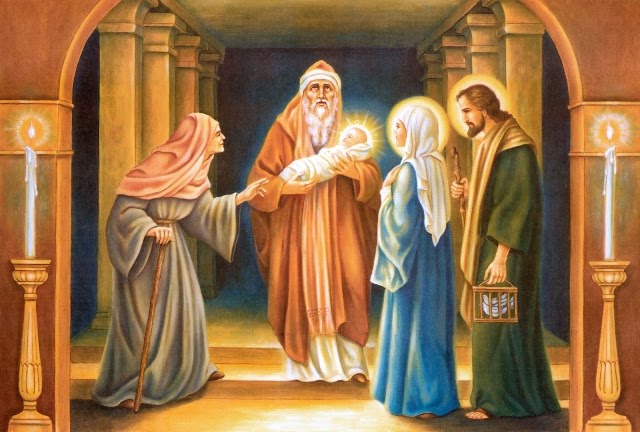
Today we celebrate the Feast of the Presentation of Jesus in the Temple. This feast is 40 days after Christmas, and marks the end of the traditional Christmas season.

The Gospel recounts how, in fulfillment of the Law of Moses, Mary and Joseph bring the infant Jesus to the Temple to consecrate him to the Lord – to “redeem” Him – as was required of all firstborn sons – at the cost of two turtledoves.


In a sense, this was the discount rate for poor couples – as the regular rate was to sacrifice a lamb.

How strange – the Redeemer is redeemed?

The Lamb of God cannot afford a lamb?

Or that the Son would need any further consecration to the Father from whose heart He was begotten?

Perhaps this is what Simeon was alluding to by calling the Christ child “a sign that will be contradicted” … among many other things.

Equally contradictory is that God the Son – incarnate as a human infant – enters the Temple built to worship Him … and almost nobody seems to notice. Nobody, except a elderly man and an elderly woman.


In today’s Gospel, Simeon prophesies that “a sword will pierce” Mary’s heart, “so that the thoughts of many hearts may be revealed.

Similarly, in ending his Lenten reflections, Cardinal Wojtyla – Saint John Paul II – juxtaposes the “sign of contradiction” … that is, Jesus – Our Lord; and the “sign that appears in the heavens” in Revelation 12 … that is, Mary – Our Lady.


Today, the nativity scene in the Vatican will be taken down. And in three weeks and three days, we will begin the 40 days of Lent. Followed by Holy Week and Easter; and the 40 days of the Easter season.

40 days, symbolic of the 40 weeks from conception to birth for a human baby. 40 days, symbolic of spiritual rebirth.


In the fifth reflection from that 1976 retreat, on the Joyful Mysteries of the Rosary – and the fourth Joyful Mystery is the Presentation in the Temple, today's feast – John Paul says:
[Christ’s] reign begins when [this] temple sacrifice is offered in accordance with the [Mosaic] Law, and it attains full realization through [His] sacrifice on the cross, offered in accordance with an eternal plan of love.
As we approach this altar to receive the Sacred Body and Blood, Soul and Divinity of Jesus Christ; let us pray that we might engage more deeply the graces of our own redemption in Christ Jesus … poured out from this altar … in the perpetual remembrance of that eternal plan of love.