Showing posts with label Birch Run. Show all posts

Saturday, February 12, 2022

6th Sunday of OT @ Ss. Francis and Clare

HOMILY 6TH SUNDAY OF ORDINARY TIME
FEBRUARY 12/13, 2022


The 1987 movie, The Princess Bride, was produced and directed by Rob Reiner (Meathead from All in the Family), and had among its cast Andre the Giant, Peter Falk (Columbo), Fred Savage (The Wonder Years), and Billy Crystal (Saturday Night Live.)

The movie is the acting out of a book that a grandfather reads to his sick grandson – who is not at first impressed. It’s a love story, after all. And it’s dull – all that mushy stuff – until the sword fights, soldiers, and pirates.

Eventually, at what seems the end, the future princess Buttercup is about to be wed to the evil prince Humperdink. And a character known only as “The Impressive Clergyman” in the credits begins the ceremony.

MAWAGE is wot bwings us togeder tooday,
MAWAGE, that bwessed awangment,
that dweam wifin a dweam...
And wuv, tru wuv, will fowow you foweva...
So tweasure your wuv.

Thankfully, the wedding is interrupted before the vows are completed by the Dread Pirate Roberts, Buttercup is kidnapped by the pirate, who turns out to be her childhood love, Westley. After a sword fight and a seeming loss, Westley chases off the prince, and our lovers ride off on horseback … assumedly to a life lived happily ever after.

It’s available on Hulu and Disney+ if you have a subscription, or for $5 on Amazon Prime, Apple TV, and Vudu. YouTube wants $14,99 … but I don’t recommend spending that much money for a 34 year old movie.

Today is the 6th Sunday in Ordinary Time.
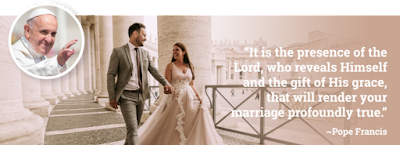
It is also World Marriage Day.

And our first two readings sort of make that really difficult. But maybe not.

Yes, Jeremiah speaks of curses, but he goes on to speak of blessings. 

Paul speaks of futility and death, but brings us back to eternal life in the midst of faith and hope.

And the Gospel. 

The reading of the Beatitudes may seem to be so familiar that we don’t really listen. Out of the four Gospels, they are only found in Matthew and Luke.

This reading from Luke only occurs twice in the entire Lectionary. Today, once every three years, and on a Wednesday some time in September.

Matthew’s version, on the other hand, would have been two weekends ago last year, and on a Monday in June. 

It is also read on All Saints Day and All Souls Day; at Funerals, Ordinations, and Confirmations. And last, but not least, it is one of the many options for celebrations of Matrimony.

The word translated here as “blessed” has also been rendered as “happy.” Depending who’s approving what translation, it goes back and forth every 20 or 30 years. Blessedness – or

Beatitude is a possession of all things held to be good,
from which nothing is absent that a good desire may want.

At least according to the 4th century Saint, Gregory of Nyssa. And he goes on to say that Beatitude – being blessed – can only be fully understood in comparison to it’s opposite: misery, affliction, and suffering. 

And so, our readings may very well have a point. There are blessings, and there are curses. And hopefully you are married to the former, and not the latter. There is at times futility, and we all do die; but faith, and hope, and love help us to chart the stormy waters of the messiness of life … leading us to resurrection with Christ. 

And, of course, there are blessings and woes … but in the end, eternal life and in-between some happiness.

As we approach this altar to receive the Most Holy Body and Soul and Divinity of Jesus Christ, may the graces we receive in this Sacrament empower all the other Sacraments we have received … for a deeper outpouring of Faith, Hope, and Love … and may we receive, at the table of the Lord, many blessings … and much joy and happiness.

Sunday, February 6, 2022

5th Sunday of OT @ Ss. Francis and Clare

HOMILY 5TH SUNDAY OF ORDINARY TIME
FEBRUARY 5/6, 2022

Regula Sancti Benedicti The Rule of Saint Benedict, was written in 516 AD by Saint Benedict of Nursia. It followed most community rules up to that point, but it sought to moderate monastic life between personal zeal and institutional formalism. In its original Latin, it consists of 13,317 words, 638 sentences, in 73 chapters. It’s not that big of a book. My own copy is only 111 pages, including the table of contents and the translator’s notes.250 years after it was written, Charlemagne had it copied and distributed throughout western Europe to encourage monks to follow it as a standard. Perhaps its most important influence was to set forth the idea of a written constitution and a rule of law.

The majority of the text covers the “how, what, whys, and whens” of operating a Monastery. Who gets what, how much, when and why. Everything from food, clothing, work, prayer, sleep, and punishment.

There are two chapters which perhaps we can take up on our own – Chapter 4 and Chapter 7.

Chapter 4 provides 73 Tools for the Christian Life, and Chapter 7 lists Twelve Steps of Humility.

Both of which are going to get really important in 3-1/2 weeks when Lent comes around!


The twelve steps of humility from Chapter 7 of the Rule are:

i. Fear God, ii. Follow God’s Will, iii. Follow Church Authority, iv. Even When It’s Hard, v. Confess Sins, vi. Reject Entitlement, vii. Esteem Others, viii. Stay in Community, ix. Listen Before Speaking, x. Don’t Be Silly, xi. Watch What You Say, xii. Be Your True Self.

And far from being a “self-help” chapter, the emphasis throughout is that it is God’s work in us … not our own work … that can help us grow in humility.

Today is the 5th Sunday in Ordinary Time. 

Our readings today have an undercurrent of Humility.


Isaiah has a vision of God, and in this vision he receives an insight – who he is before God Almighty:

Woe is me, I am doomed!
For I am a man of unclean lips,
living among a people of unclean lips.

Yet, God sends a seraphim – the angels that burn with a passion and love of God – to remove any wickedness and purge any sin. And at that moment, Isaiah responds to God: “Here I am, send me!”


In our second reading, St. Paul speaks of the proofs of the resurrection – Salvation, Scripture, and the many witnesses. And although Paul, himself, is an Apostle and a witness of Christ, he downplays it, calling himself:

the least of the apostles,
not fit to be called an apostle,
... [a persecutor of] the church of God.

Like Isaiah, Paul’s solution comes from above … God’s effective grace working within him.

And in the Gospel, Luke chapter 5, Jesus calls His disciples. But the story is perhaps too familiar.


If we place ourselves in the story, what do we see? 

A local carpenter walking on the beach gets into somebody else boat, talks for a while, and then starts to tell a group of fishermen, who are done for the day, what they should do to improve production. After an initial protest, they comply. And the result is “a great number of fish … that filled both boats.

St. Peter sees this for what it is – a miracle – and falls “at the knees of Jesus and [says], ‘Depart from me, Lord, for I am a sinful man.’

Humility. Humility. Humility.

Humility can be defined as “the virtue that … leads people to … a true appreciation of their position with respect to God and … neighbor.”


Isaiah, St. Paul, and St. Peter all found themselves in the Presence of God … whether in a vision or in the flesh. And all three were led to a humble recognition of who they were … and through God’s power were called to a greater mission.

As we approach this altar to receive the Sacred Body and Blood, Soul and Divinity of Jesus Christ – when we find ourselves in the Presence of Christ Jesus under the appearances of Bread and Wine – may we gain the strength to truly appreciate who we are before God … and through God’s love and grace and mercy, may we recognize who He is calling us to become … as we strive to follow Him … He Who is our Way, our Truth, and our Life.

Saturday, December 4, 2021

2nd Sunday of Advent @ Ss. Francis and Clare

HOMILY 2ND SUNDAY OF ADVENT
OCTOBER 30/31, 2021


Born in Birmingham, England in 1849, Frederick Langbridge studied at King Edward VI’s School, and then matriculated at Oxford University, earning his Bachelors at St. Alban Hall, and his Masters from Merton College. 

He was an Anglican cleric, ordained in 1876; and was a canon of St. Munchin’s, as well as rector of St. John’s in Limerick, Ireland. 

He was a poet, an author, a playright, and a noted preacher.  

He is credited with the couplet:

Two men look out the same prison bars; 
one sees mud and the other stars. 

Langbridge retired in 1921 due to ill health, and died in 1922 at the age of 72.  


Today is the Second Sunday of Advent.

Our first reading is from the Prophet Baruch, who was the secretary of the Prophet Jeremiah. The book is considered apocryphal by non-Catholics, but is similar to the writings of Jeremiah during the Babylonian captivity.


In today’s reading, from the last chapter of Baruch, we hear the prophet admonishing the people to move from “mourning and misery” and look toward a future of “glory from God forever.” He speaks of “justice,” “peace,” “joy,” “mercy,” and “light.” 

In the second reading, from St. Paul’s Letter to the Philippians, Paul also is in custody. Yet, he too speaks of “joy,” “confidence,” “good works,” “affection,” “love,” “knowledge,” “discernment,” “purity,” “righteousness,” and “glory.”


Two men, indeed, both held captive in a prison of sorts … both calling upon their listeners – and us as well – to look up from mud, and see beyond the starts … to the glory of God.

St. Luke speaks of St. John the Baptist, quoting Isaiah 40, which parallels sections of today’s reading from Baruch:

God has commanded
    that every lofty mountain be made low,
that the age-old depths and gorges
   be filled to level ground.

As we approach this altar to receive the Sacred Body and Blood, Soul and Divinity of Jesus Christ … let us keep our eyes fixed on Jesus … gazing beyond the heavens to the glory of God … promised to us through, with, and in Christ.


And as we continue to proceed through these 4 weeks of Advent … may we draw ever closer to Him … glory to glory … grace upon grace … as we prepare ourselves for the three comings of Christ … historically at Christmas … imminently in the Sacrament of the Altar … and ultimately when we meet Him face-to-face.

Saturday, October 30, 2021

31st Sunday OT @ Ss. Francis and Clare

HOMILY 31st SUNDAY IN ORDINARY TIME
OCTOBER 30/31, 2021


Barbara Woodhouse was born in 1910 in County Dublin, Ireland. She is best known for her 1980s British television show, and her series of books on Dog Training. Her motto was “no bad dogs,” and her particular style of Obedience Training continues to be taught in Britain and the US to this day. 

Obedience training for dogs has its roots in pre-history. Over 100 years before the time of Christ, a Roman farmer recorded advice for training dogs to herd livestock.

In the 19th century, a British Army Officer published a book titled: “Dog Breaking: The Most Expeditious, Certain and Easy Method, Whether Great Excellence or Only Mediocrity Be Required, With Odds and Ends for Those Who Love the Dog and the Gun,” intended to train hunting dogs.


And in 1911, a German military officer published his book, titled: “Training Dogs: A Manual,” still used today to train police and military dogs.

Woodhouse died in 1988 at the age of 78; but her method lives on. Her American protege, Brian Kilcommons, is an expert trainer and counts among his clients Diana Ross, Morley Safer, and Diane Sawyer. 


Today is the 31st Sunday in Ordinary Time.

Our Old Testament and Gospel readings both focus in on a single prayer, known to Jews as the Sh’ma.

Hear, O Israel!
The Lord our God is Lord alone!
You shall love the Lord your God with all your heart,
with all your soul, 
with all your mind,
and with all your strength.

Looking at the original languages for the two readings it would appear that something has gotten lost in the translation from Hebrew to Greek to English.

The English word, hear, is defined by the Oxford dictionary as “to be aware of sounds with your ears.” And, interestingly, this comports pretty much with the Greek word used in the Gospel for ‘hear’ which is “akoue” and is where we get the English word “acoustic.”

Both the Greek and the English words imply what appears to be a passive event – mere sounds flowing into our ears.

But the Hebrew word “sh’ma” means more than just ‘hear.’ It also means to ‘listen, consent, understand, and obey.’ To hear God is to conform your will to God’s and to act on God’s word and to obey God’s word.

Hearing implies obedience, and obedience implies action.

In the Letter to the Hebrews, we hear at the end of the reading the phrase “the word of the oath” which points back to a covenant. And the covenant for us is found in our encounter with Christ in the Sacraments of the Church … and in the superabundant sacramental grace provided by the Sacraments in order for us to live out our lives in the world by leveraging the Supernatural virtues of Faith, Hope, and Love.

As we approach this altar to receive the Sacred Body and Blood, Soul and Divinity of Jesus Christ, may His “once for all” offering on the Cross “always … save [us] who approach God through [H]im,” with Him, and in Him. May the graces we receive this day in the Sacrament of the Altar help us to hear, listen, obey, and act upon the Word of God in our daily lives by what we say and do out and about in the world.

Monday, October 25, 2021

30th Sunday OT @ Ss. Francis and Clare

HOMILY 30TH SUNDAY IN ORDINARY TIME
OCTOBER 23/24, 2021


In the United States, roughly 1 million people are blind. There are an additional roughly 3 million people who have an uncorrectable visual impairment, and another 3 million who have a correctable visual impairment, but are unable to obtain medical intervention. Meaning, nearly 7 million “blind people” in the US.

While there are many things that can cause blindness, three of the top several diseases are (1) Cataracts, (2) Age-related Macular Degeneration (or AMD), and (3) Glaucoma. These aren’t the only causes, but for the point of illustration, they are the three I’ll be discussing.

Cataracts are caused by a clouding of the lens or lenses. AMD is caused by a degeneration of the back of the eye, obstructing the image coming into the eye right in the middle. Glaucoma, on the other hand, damages the optic nerve, causing the edges off the image to be lost to the viewer.

Blindness is in the top 10 disabilities, ranking at number nine, falling just before stroke (at number 10) and after diabetes (at number 8.)

Today is the 30th Sunday in Ordinary Time.

Our Gospel Reading is the story of the blind man known to us as Bartimaeus … which is Aramaic for “son of Timaeus.” 

The story in itself is remarkable. He is a beggar. And when he hears that Jesus is passing by, he begins crying out. The crowd tries to shut him up … not a very nice thing to do … especially when the person passing by is a noted healer. And when he does go to Jesus, he gets up and throws aside his cloak … which is his coat, his umbrella, and most likely his home.

This chapter from St. Mark’s Gospel begins with Jesus speaking about the divine plan for marriage which was stricter than the practice of the time. The disciples shooing away children, and Jesus reversing that and allowing the children to come to Him and blessing them. Next, Jesus sets a high bar for a rich young man, who goes away sad … not willing to come to Jesus with nothing. Jesus then begins to speak of His passion, death, and resurrection.

As if oblivious to this, two of the apostles ask for top spots in the Kingdom of Heaven … ticking off the other 10 apostles who wish they had thought of it first. And then we have today’s story of Bartimaeus.
Why this story here?

Well, the apostles have been missing the mark so far, being confused on marriage, children, property, and power. The placement of a story of a blind man right after these seems to point to Spiritual Blindness.

There are three ways to look at Spiritual Blindness. One can be ignorant … not knowing, or not wanting to know about God or Jesus or the Gospel. One can be cynical … not seeing the goodness of God or thinking that everyone is out for themselves. And finally, one can have a hardness of heart … not wanting to love, or not feeling worthy of love.

These three causes of Spiritual Blindness … ignorance, cynicism, or heart-heartedness … do have cures. And the physician is Jesus … the Divine Healer … who comes to us with Faith, Hope, and Love.

Faith overcomes spiritual ignorance … Hope overcomes spiritual cynicism … and Love overcomes hardness of heart.

Finally, the last two stories in this chapter from St. Mark have Jesus asking the same question … first of his two power-hungry disciples and second of blind Bartimaeus. The question is:

What do you want me to do for you?

And that is the question I’ll leave you with. “What do you want Jesus to do for you?” 

As we approach this altar to receive the Sacred Body and Blood, Soul and DIvinity of Jesus Christ … as we receive Him … materially and spiritually … ask Him for whatever you want. And if you’re not sure what you want, ask Him for a deeper outpouring of Faith, and Hope, and Love. And as you receive from Him the graces of this Sacrament, know that “your faith has saved you,” and renewed by that faith … go on your way through, with, and in Christ Jesus Our Lord.

Sunday, October 3, 2021

27th Sunday OT @ Ss. Francis and Clare

HOMILY 27TH SUNDAY IN ORDINARY TIME
OCTOBER 2/3, 2021


St. Francis of Assisi has been given a bad reputation in the modern era. He’s been co-opted by hippies, environmentalists, and others . . . for themselves, and without regard to who he really was. 

Francis felt called to serve in a heroic way. Twice, he tried to go to war. The second time, he had a dream with instructions sending him home. And so, he did – selling his armor and sword, and giving it to the poor. He spent time in prayer, seeking to know . . . more and more perfectly . . .  the will of God for his life. 


While in the chapel of the Monastery of San Damiano, the crucifix spoke to him . . . telling him three times: “go and repair my church which, as you see, is all in ruins!

Initially, Francis thought that the point of the message was to rebuild that particular chapel. Later, he would realize that he was called to rebuild the Church – the big “C” church – reforming the Church, by demonstrating that the Gospel was not beyond being lived out day-by-day by ordinary people . . . in a spirit of charity and poverty.

He founded three orders: (1) the friars minor – or the “little brothers,” (2) the “poor Clares,” and (3) the “brothers and sisters of penance” – or what is now known as the “Third Order.”

Francis embraced the Gospel literally and radically, and this should give us all pause . . . begging the question: “Do we really allow the message of the Gospel to penetrate into the depths of our being?

Francis realized that God had given us everything, and he desired to give everything to God. 


Today’s readings, for the 27th Sunday in Ordinary Time, speak of the first covenant given by God to humanity – that is, Marriage.

A covenant is similar to a contract. But, where a contract is an exchange of goods . . . a covenant is an exchange of persons . . . that is, the establishment of a relationship. 

The best example of this is Matrimony, where husband and wife give themselves to each other completely: “in good times and in bad, in sickness and in health.” to love and honor each other ”all the days of [their lives].” Marriage reflects the relationship of Christ and His Church.


In the same way, the other six Sacraments are also covenants – where we are brought into a deeper relationship with God in Christ through the power of the Holy Spirit.

Baptism, Confirmation, Eucharist – the Sacraments of Initiation – bring us into relationship with the Most Holy Trinity.

Reconciliation and Anointing – restore us spiritually and physically according to God’s Will. 

And Matrimony and Orders create a visible community . . . a family of Faith, Hope, and Love . . . to build up the Kingdom of God in the world.


St. Francis saw himself as the herald of a great King – that is, he proclaimed the Kingdom of God in a world . . . which like our own . . . had grown cold. Francis was a fire burning in that cold world . . . an intense fire of Divine Love.

Francis sought to live the Gospel in such a way as to be a living Gospel. His message was the message of Christ. And his life was lived for Christ.

And, as his mission found it’s origin with a message from the cross . . . toward the end of his life, he bore the stigmata – the wounds of Christ – in his own body . . . for the last two years of his life. And up and until he died, he was a living image of Our Savior on the Cross.


As we approach this altar to receive the Sacred Body and Blood, Soul and Divinity of Jesus Christ . . . let us, in this covenant meal of the Eucharist, receive Christ totally . . . as we give ourselves totally to Him. And through the intercession of St. Francis . . . and in following his example . . . let us strive to give ourselves entirely to Christ . . . “through Him, with Him, and in Him” . . . may we – in all that we say, and in all that we do – bring the Gospel to the world by the manner of our own lives . . . in relationship to God and to His Church. 

Saturday, August 7, 2021

19th Sunday in OT @ Ss. Francis and Clare, Birch Run

HOMILY - NINETEENTH SUNDAY IN ORDINARY TIME
AUGUST 7/8, 2021

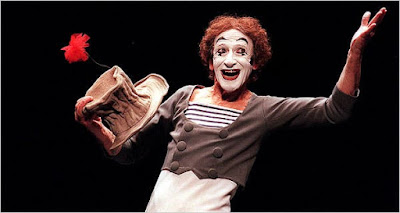
Marcel Marceau was a French actor and mime, most famous for his stage persona “Bip the Clown.” He was born into a Jewish family in 1923, and owing to the Second World War, spent a good portion of his youth in hiding. His father was deported to the Auschwitz concentration camp, and died there. Marceau and his brother Alain joined the French Resistance, and worked to save innumerable children from capture and deportation.

His mime routines, included The Cage, Walking Against the Wind, The Mask Maker, and In The Park. All of these are considered today to be classic routines.


When he was 5 years old, his mother took him to a Charlie Chaplin film, which captivated his imagination, and attracted him to mime and acting.

He called mime, The Art of Silence, explaining in a 1987 interview:

The art of silence speaks to the soul, like music, making comedy and tragedy, involving you and your life. . . . creating character and space, by making a whole show on stage - showing our lives, our dreams, our expectations.

He received world renown and held many high international honors in the arts. He died in 2007 at the age of 84.


Today is the 19th Sunday in Ordinary Time.

In St. Paul’s Letter to the Ephesians, he exhorts us to “be imitators of God,

The word St. Paul uses here that is translated “imitators” is μιμητής (mimÄ“tḗs) – which is where we get the English words mime, mimic, and mimeograph ... to name a few.

We are to imitate God, however, not just by copying Him or by mimicking Him, but rather – as St. Paul says – “as beloved children, [to] live in love, as Christ loved us and handed himself over for us as a sacrificial offering to God for a fragrant aroma.


And so the starting point, is love. And not a gushy modern melodramatic love, but rather a tough love ... a difficult love ... a sacrificial love.

In the Gospel, we continue with John chapter 6, and Jesus continues to expound on what we heard last week, where He told His listeners that He, Himself, is the Bread of Life.

This sets the people off, as they start to run through what they understood of Jesus’ background. They knew Him ... or at least they thought they knew Him.

Yet Jesus repeats Himself, restating, “I am the Bread of Life”, telling them that “whoever believes has eternal life” and whoever “eat[s] it [will] not die.


And finally today’s passage from the Gospel ends with Jesus saying one more time:

I am the living bread that came down from heaven;
whoever eats this bread will live forever;
and the bread that I will give is my flesh for the life of the world.

In the Eucharist, we receive the Body of Christ. Our “Amen” is a profession of our faith in that reality – a reality that transcends the material world.

Three characteristics of the host we receive – visible to all – give us an insight into how we are to imitate God.


The host is small. Reflecting the humility of God – not only in becoming a human being in the Person of Jesus Christ, being born in a stable, and living a relatively obscure life in a small back-water of the Roman Empire ... but also in that He still comes to us under the form of bread and wine. Because His coming is so humble, we can miss it if we are not attentive to the mystery ... the miracle before us. We are called, as well, to humble ourselves ... so that we might not miss God’s presence in our midst.

The host is round. Reflecting the eternity of God. We are called to believe in Jesus Christ, and are to call him Savior, Brother, Son of God. A living faith is our ticket to eternal life ... and so, we too are called to live with Christ in the Kingdom of God ... in eternity.

The host is white. Reflecting the purity of God. At the end of Revelation chapter 21, we are told that “nothing unclean will enter [heaven].” And so, we are called to live our lives in purity and holiness.


As we approach this altar to receive the Sacred Body and Blood, Soul and Divinity of Jesus Christ, let us pray for the grace we need to truly imitate God in all that we say and all that we do. And as we receive the Eucharist from this altar today, let us heed the words of the angel to Elijah: “eat, [or] else the journey will be too long.” And as we eat, may we remember that we are called to embrace humility, purity, and eternity – imitating God in all things, but especially in His Love.

Saturday, July 31, 2021

18th Sunday in OT @ Ss. Francis & Clare, Birch Run

HOMILY - EIGHTEENTH SUNDAY IN ORDINARY TIME
JULY 31 / AUGUST 1, 2021  


In a book on spirituality, Jesuit author J. Francis Stroud tells a story about how to catch a monkey. It goes as follows:

In India hunters have a simple but effective way to capture monkeys. They cut a hole in a coconut large enough for the monkey’s hand to go in, but small enough to hold it captive if it makes a fist. They then put a banana into the coconut and wire the coconut to a tree. The monkey puts its hand into the coconut, grabs the banana, but cannot get its hand out because it won’t open its fist and let the banana go.

Today is the 18th Sunday in Ordinary Time.


In the first reading, we hear how the Israelites “grumbled” that they had no food. The Lord sends down the miraculous rain of man’na – the word supposedly means “what is this?” in Hebrew.

In the Gospel, after Jesus challenges the people who had eaten the miraculous multiplication of loaves and fishes, they turn on Him and ask: “What sign can you do, that we may see and believe in you? What can you do?

They even recall the miraculous rain of man’na that their “ancestors ate ... in the desert.

What Jesus does tell them is that His “Father gives you the true bread from heaven” and that this bread “gives life to the world.

They immediately respond, “Sir, give us this bread always.

The crowd flips and then flops. They eat the bread Jesus miraculously multiplied, and follow Him across the sea. When Jesus challenges them, they turn on Him and demand a sign. He ignores their challenge, and instead tells tells them that His Father is the source of this bread. Then they ask for this miraculous bread always. Flip. Flop. Flip. Flop.

It may be helpful to realize that a few chapters after the scene we heard from the Old Testament in Exodus, the people who are at first impressed with the miraculous man’na ... after eating it day-in and day-out, go back to complaining – later on – about how sick they are of the man’na.

Is this some odd trait of human nature? When confronted with a miracle, there is an initial amazement, but after a while ... miracle schmear-a-cle ... and they’re on to something new. Or else get excited about a miraculous free lunch, but when challenged, make demands for more miracles.


Saint Paul provides a clue in his Letter to the Ephesians, where he exhorts us to “put away [our] old self ... and be renewed in the spirit of [our] minds.” By putting on a new self, he tells us we will be re-created “in God’s way in righteousness and holiness of truth.

Like the monkey, caught in the coconut trap, we need to be constantly reminded to put away our old self ... our old habits ... our old sins ... our old ways of thinking. We get caught in the trap of the past and it seems that under our own power we just can’t let go.


Every week, we come here to worship God. In a miraculous re- presentation of the Sacrifice of Jesus on the Cross, we are given His Body and Blood, Soul and Divinity under the form of bread and wine.

But are we trapped in worldly values and habits that prevent us from being renewed in Christ? Are we clinging to an old self or past hurts or perceived slights? Are we trapped in habitual sins that we refuse to repent of or be freed from? Are we unable to let go of all of this and allow the grace of God to re-create us in holiness and righteousness?

Do we flip ... flop ... flip ... flop between sin and virtue without any end in sight?

The answer is – Let Go and Let God. Jesus Christ is truly here ... in the Word of God ... and in the Blessed Sacrament of the Altar. We must, indeed, put away our old self, old ways, old habits, and old sins ... and allow God’s grace and mercy to renew us in Christ.

As we approach this altar to receive the Sacred Body and Blood, Soul and Divinity of Jesus Christ, let us pray for that renewal in our hearts, minds, and bodies. Let us see the miracle of grace that is here before us. Let us fix our eyes on Jesus Christ – the Bread of Life – and receive the new life that we have been promised ... in Christ Jesus our Lord.