Tuesday, May 23, 2017

Tuesday 6th Week of Easter @ St. Apollinaris School

HOMILY GRAPHICS - TUESDAY 6TH WEEK OF EASTER
MAY 23, 2017
8:45 AM ORDINARY FORM MASS (4TH, 5TH, 7TH, 8TH GRADES)


In the Gospels for the past few days, Jesus keeps talking about "the Advocate."

This is the Greek word "Paraclete" which means "someone to stand by you." Since English doesn't have a specific word for that, it's sometimes translated "comforter," "helper," "consoler," "mediator," and probably other ways, too.

The "Advocate" is the Holy Spirit, who comes to us in both Baptism and Confirmation.

We hear about, and study the Gifts of the Holy Spirit. But it's more than just a list.

The Gifts of the Holy Spirit, according to the Catechism of the Catholic Church, perfect the Virtues. So, we need to know about the Virtues, too. But this is more than a list.

Some of the Virtues are "infused" at Baptism. These are Faith, Hope, and Love. But like muscles and brainpower, if you don't exercise these Virtues ... they don't get very strong.

The other Virtues are the "human" virtues – prudence, temperance, fortitude, and justice. These we develop by thinking the right way, acting the right way, behaving the right way, and being the way God has created us to be. When we do bad things, think bad thoughts, do wrong things – we don't become "bad" in and of ourselves, but we weaken the ability of God's grace to perfect us.

If we don't build up our virtues, there isn't anything for the Holy Spirit to perfect through His Gifts.

Similarly, there are also the Fruits of the Holy Spirit. Another list you have to memorize. But it's more than a list.

The Fruits of the Holy Spirit are a foretaste of Heaven for us, here on Earth. When we build a foundation of Virtue, and through Grace allow the Holy Spirit to act in our lives and perfect those virtues with His Gifts, we will experience the Fruits of the Holy Spirit in our daily lives.


And so, it is like building a house. We build our spiritual "house" on the foundation of the Virtues, and through the Sacraments, receive the Gifts of the Holy Spirit which build us up by perfecting those virtues, and as we continue to live virtuous lives in God's grace, we begin to experience the Fruits of the Holy Spirit in our lives.

Saturday, May 20, 2017

6th Sunday of Easter @ St. Apollinaris Church

HOMILY - SIXTH SUNDAY OF EASTER  (YEAR A)
MAY 21, 2017
7:30 AM, 5:30 PM ORDINARY FORM (ENGLISH) MASSES


Statics is the branch of engineering mechanics that analyzes the forces and torques acting on a physical system that is in static equilibrium with its environment. In other words, the structure or system isn’t going anywhere; and by design, it shouldn’t be going anywhere.

Granted, this is a simplification that is used early on in an engineering curriculum to allow a student to begin to learn how to design structures – like buildings or bridges – that are mostly stationary.


Now, anyone who’s ever been in a high-rise building; or driven on a bridge in high winds, knows that structures are rarely stationary. And in fact, it is disastrous to design a structure so rigid that it is unable to experience an appropriate amount of give and take with natural movements in the environment.

Nonetheless, the study of statics allows a student to gain familiarity with structural and supporting members and to gain some knowledge of various aspects required to construct basic physical systems.


Today is the Sixth Sunday of Easter.

In today’s Gospel taken from St. John’s Gospel chapter 14, Jesus speaks of the Holy Spirit as the “Spirit of truth.” He uses a word, translated here as “Advocate,” literally (from the Latin) someone who speaks for a person or for a cause – colloquially a supporter or a proponent.

The word here in the Greek is (parakletos and is) sometimes translated as comforter or consoler. Comfort comes from the Latin (con + forte) and means to give someone strength. Consoler is also from the Latin (con + solare) and means to give someone support.


Our modern lives are often structured in such a way that we have no place for rest … no room for relief. Yet, if we find ourselves ready to collapse under the weight of many responsibilities we need to seek relief from the Holy Spirit – the Third Person of the Trinity – He whom Jesus calls the “Advocate” to be with us in those times when we need extra strength and added support.

Without the spiritual help of the Holy Spirit, we most certainly will have difficulty not only in living the Christian life; but also in just getting through the day.

The Holy Spirit comes to us in Baptism – our first experience of His strength and support. Yet, more specifically, we associate the Holy Spirit with Confirmation – in which we receive the Holy Spirit in a way that fortifies and builds us up for mission – to be apostles – in the world.


Through Baptism, we have been made sharers – partakers – in the Divine Life of God – Father, Son, and Holy Spirit. United with Christ as members of His Body, we receive adoption as daughters and sons of the Father; and through our participation in the Trinitarian mystery of the Godhead, are filled with the Holy Spirit.

By our connection with God – who in His being is Love – we are then able to love as we are called to love; and to live in His love – through our sharing in God’s being.

As we heard in the First Reading from the Acts of the Apostles, the Holy Spirit led the early Church from Jerusalem, through Samaria in the north, and out into the world. We must allow the Holy Spirit to direct us to be firmly rooted in our faith, yet flexible enough to follow the promptings of the Spirit.


In the Epistle, St. Peter tells his listeners, and us as well, to be able to “give an explanation … a reason for our hope.” The words here mean “a word from,” and “the word.” And so, by keeping Christ in our hearts, we will have a clear conscience – which might also be translated as “to give clear knowledge or understanding.” And so, again, we see the action of the Holy Spirit in imparting His gifts to the Church.

As we approach this altar to receive the Sacred Body and Blood, Soul and Divinity of Jesus Christ, let us pray for a deeper outpouring of the Holy Spirit – given to us at Baptism and strengthened at Confirmation. May the gifts of the Spirit build upon our the foundation we have laid, so that we might allow the Holy Spirit of God to fill us with His power, to transform us into the image of Christ – members of the household of God the Father … and filled with the grace, and mercy, and love of the Holy Spirit.

Jeopardy @ St. Apollinaris Parish Retreat

JEOPARDY - PARISH EASTER RETREAT INTERMISSION
MAY 20, 2017
1:00 PM


AROUND THE WORLD

100 The approximate population of Catholics in the world.
What is one billion.
200 The continent with the largest number of Catholics.
What is South America.
300 The number of Catholic priests in the world.
What is four hundred thousand.
400 The country with the highest Catholic population.
What is Brazil
500 The city, besides the Vatican, housing the most relics.
What is Pittsburgh. 

WHO’S WHO IN 33 AD

100 Jesus’ grandmother.
Who is St. Anne. 
200 The Apostles mentioned most in the Gospels.
Who is St. Peter. 
300 St. Luke’s occupation.
What is physician (doctor).
400 The Apostle to the Gentiles (not one of the twelve.)
Who is St. Paul (or Saul of Tarsus).
500 A dove told him Jesus was the Son of God.
Who is John the Baptist. 

BOOKS OF THE BIBLE

100 He wrote the first five books of the Old Testament.
Who is Moses. 
200 The number of New Testament authors.
What is 10. (9 is also acceptable.) 
300 Two out of the four Major Prophets. 
Isaiah, Jeremiah, Daniel, Ezekiel
400 The two bishops addressed in the Pastoral Epistles.
Who are Timothy and Titus.
500 The number of Minor Prophets.
What is 12. 

HOLY, HOLY, HOLY

100 A gift from Our Lady, still present in Lourdes, France.
What is a miraculous spring of water. 
200 The author of St. Faustina’s diary?
Who is Jesus Christ. 
300 Levitation earned this saint the name “the flying friar.”
Who is St. Joseph of Cupertino. 
400 This saint is mentioned in the Ambrosian Canon.
Who is St. Apollinaris of Ravenna.
500 This 20th century flying friar chased bombers away from his hometown.
Who is St. Padre Pio (of Pietrelcina) 

MASS APPEAL

100 Vatican II said to hold this musical instrument in highest esteem at Mass.
What is the pipe organ. 
200 The number of Bible readings at Mass on a Sunday or Solemnity.
What are three
300 A ferial Mass is this.
What is a daily Mass. 
400 This hymn is sung before the Collect on Feasts or Solemnities.
What is the Gloria (Glory to God.) 
500 This prayer, dating to the 4th century, is known as the Canon of the Mass.
What is Eucharistic Prayer I. 

JESUIT INITIALS

100 S.J.
What is Society of Jesus.
200 I.H.S.
What are the first three letters of “JESus” in Greek. 
300 F.X.
What is (Who is) Francis Xavier.
400 S.T.D.
What is Doctorate in Sacred Theology.
500 A.M.D.G.
What is For the Greater Glory of God. 


POPE CULTURE

FINAL
Besides being popes mentioned in the Roman Canon, what do Linus, 
Cletus, Clement, Sixtus, and Cornelius all share in common?
What is martyrdom. 

THANK YOU TO OUR THREE CONTESTANTS! 

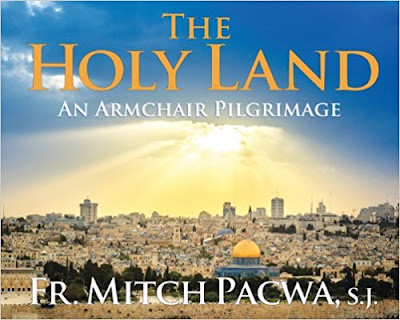
First Place won a copy of Fr. Mitch's book "The Holy Land: An Armchair Pilgrimage," 

https://www.amazon.com/Holy-Land-Armchair-Pilgrimage/dp/1616366133

and the runners up won copies of Fr. Mitch's book "The Holy Spirit: A Bible Study Guide for Catholics."

https://www.amazon.com/Holy-Spirit-Bible-Study-Catholics/dp/1612789595/ref=tmm_pap_swatch_0?_encoding=UTF8&qid=&sr=

THANK YOU, ESPECIALLY, TO FR. MITCH PACWA, S.J. FOR AN ENTERTAINING, INSPIRATIONAL, AND EDIFYING DAY OF MASS AND RETREAT TALKS!

Thursday, May 18, 2017

Thursday 5th Week of Easter @ St. Apollinaris School

HOMILY - THURSDAY 5TH WEEK OF EASTER
MAY 18, 2017
8:45 AM ORDINARY FORM MASS (2ND GRADE)


Today, we hear Jesus tell us to "Remain in His Love."

We get lots of images of love in our day-to-day lives.

The Beatles told us "All You Need is Love," we are inundated with messages of love at Valentine's Day, and even the popular culture has postage stamps, cartoons, and bumper stickers about love.

But this is the type of love that "loves ice cream." That is until we get a stomach ache from eating too much. Then we don't have much feeling for ice cream, except maybe nausea.

Jesus tells us to "remain in His Love," and that calls us to be with Jesus – and God the Father – all the time, in every place, with every thought, and every action. To live, breathe, think, and act ... through, with, and in God.

Because, while there are many things that come and go in our lives claiming to be love, God – in His entire being – IS LOVE!

So to remain in God's Love is to remain in God. To remain, abide, continue, endure, live, or await – all in God, and all in His Love.

Ice cream may or may not be something worth loving, but God is always Love, will always love us, and will always be lovable.

And so, to remain or abide in God's Love, we must follow Jesus; receive His grace, mercy, and love; and trust in His Word and in His promises.

Tuesday, May 16, 2017

Tuesday 5th Week of Easter @ St. Apollinaris School

HOMILY - TUESDAY 5TH WEEK OF EASTER
MAY 16, 2017
8:45 AM ORDINARY FORM MASS (4TH GRADE)


Today is the feast day of St. Brendan, an Irish saint. He was born in 484 AD, in Ireland, County Kerry, in the town of Tralee. He was ordained a priest in 510 AD, and about two years later began traveling to spread the Gospel.

We know that he travelled to Wales, Scotland, and England. But it is also thought that he may have travelled to Iceland, Greenland, Canada, the Azores, and the Canary Islands. Much of his travels are the stuff of legend, and it's difficult to sift the facts.

He sailed in a ship made of wood and leather, and in 1976, an Irish explorer made a replica ship out of ox hides and set sail. His adventure is told in the book The Brendan Voyage.

https://www.amazon.com/dp/B00B4XLT4I/ref=dp-kindle-redirect?_encoding=UTF8&btkr=1

St. Brendan built monasteries and churches where he went, and that is how we know for sure some of his journeys. He set out with twelve companions, and evangelized the British Isles (and possibly more places than that!)

He died in 577 AD, and is the patron saint of boatmen; divers; mariners; sailors; travellers; whales; the Diocese of Clonfert, Ireland; and the Diocese of Kerry, Ireland.

He is known as Brendan the Navigator, Brendan the Voyager, Brendan the Anchorite (a hermit), and Brendan the Bold.


The Brendan Voyage (Part I) The 1976 recreation of the voyages of St. Brendan.

The Brendan Voyage (Part II) The 1976 recreation of the voyages of St. Brendan.


Thursday, May 11, 2017

Thursday 4th Week of Easter @ St. Apollinaris School

HOMILY - THURSDAY 4TH WEEK OF EASTER
MAY 11, 2017
11:00 AM ORDINARY FORM MASS (ALL SCHOOL)


In the message of Fatima, there are three secrets.

The first secret, revealed to the children in July 1917, was that Hell is real.

That's the bad news. The good news is that Heaven is also real. And we have a choice as to which place we end up. If we love God, and follow Christ, we understand that we will go to Heaven. If we turn our backs on God, and don't follow the Gospel, it may not go well for us.

The second secret is that wars are caused by sin.

Too often, we are told that wars are caused by economic issues, territorial issues, or sociological issues. But really, when it's reduced to the lowest common denominator, the bottom line is that sin causes conflicts and wars. Being selfish, not doing what is right, going against God's will – these all end up causing strife and ultimately war.

The good news is that God sent His Son to save us from sin and our tendency toward sin. Through the Cross, we are saved, and through Baptism and the Sacraments, we are given God's grace (His power) to do the right thing and to follow Him with all our heart, mind, soul, and strength. God's grace also allows us to love our neighbor as ourself. God desires peace.

Finally, the third secret is that in the end, God's way wins.

No matter how bad things may look for ourselves or for others, God desires to save all of us.

For our part, we should pray (talk to God, and build up our relationship to Him,) do penance (to make up for our sins, and to build up our spiritual strength against temptation), and perform acts of reparation (to make up for the sins of others, through sacrifices and prayers united with the Sacred Heart of Jesus.)

God wants everyone to know the truth – and Jesus is the Way, the Truth, and the Life – so God wants everyone to know Jesus, and to be saved through His grace.

That's the message of the Gospel; and that's the message of Fatima, as well.

Tuesday, May 9, 2017

Tuesday 4th Week of Easter @ St. Apollinaris School

HOMILY - TUESDAY 4TH WEEK OF EASTER
MAY 9, 2017
8:45 AM ORDINARY FORM MASS (4TH GRADE)


In the Acts of the Apostles, we hear that in Antioch the followers of Jesus were first called Christians.

The last two weeks, we heard about the Church in Alexandria founded by St. Mark, who was succeeded a few centuries later by St. Athanasius. This week we hear of the Christians in Antioch.

Of the other ancient Christian cities, there are also Jerusalem and Rome – which you may already know about. But the fifth is Constantinople.

The word Christians comes from the word Christ (in Greek) which means Messiah (in Hebrew) which means "Anointed One."

We are also anointed. There are three oils for anointing: the Oil of the Sick, the Oil of Catechumens, and Sacred Chrism. The one named Sacred Chrism gets its name from the same word in Greek meaning anointed.

Sacred Chrism is also used in Baptism, Confirmation, and in Holy Orders (for the ordination of priests and bishops.) Sacred Chrism is also used in consecrating churches, altars, chalices, and patens.

Which brings us to the big question. If the followers of Jesus in Antioch were known as "Christians," do you live, think, speak, and act in a way that would identify you as a Christian.