Saturday, April 3, 2021

Easter Vigil @ St. Peter Chesaning

HOMILY - EASTER VIGIL IN THE HOLY NIGHT, ST. PETER CHESANING
APRIL 3, 2021

In the early 1970s, a research project at Xerox – the “Alto,” a computer that used the first Graphical User Interface, or GUI (“gooey”) – introduced the computer icon. The Alto had icons for documents, folders, computers, and people. 

In 1981, Xerox released the “Star” computer into the consumer market. It was not very well received.

Apple Computer, released the “Lisa” computer in 1983, and the “Macintosh” computer in 1984. The latter used icons created by noted artist Susan Kare, who also designed the icons for Windows 3.1 … and the rest is history.


We have just – perhaps for the first time in a long time – read through ALL 7 Old Testament readings, the Epistle reading, and the Gospel for Easter Vigil.

Congratulations!

The readings take us down a path of images, tests, promises, and redemptions … covering somewhere between 5 and 10 thousand years.

We heard first, the creation account from Genesis. God creates in pairs:

Heavens and Earth,

(Waters) Above and Below, and

Land and Sea.

He then fills them with 

Sun, Moon, and Stars; 

Flying and Sea creatures; and

Land Animals and Humans. 

Three days to create space, and three days to fill those spaces.

God’s crowning achievement is the creation of humanity. The one and only creation of His that is made in His “image and likeness.”

We then heard of the test of Abraham, sometimes called the “Binding of Isaac.”


In this account: (1) the father has a plan, (2) the son bears the burden, and (3) God provides the sacrifice. Sort of like what we heard yesterday. Although, yesterday, the Father was God, not Abraham; and the son was Jesus Christ, not Isaac.

The first story served as an “image” of the second. 

And … the site of the first story, Mount Moriah, was the eventual site of the Temple of Jerusalem, which was an “image” of Paradise, the Garden of Eden.

We then heard of the Liberation of Israel from Egypt … an “image” of their freedom from sin, and our own freedom from sin and death. 

We heard the back-to-back readings from Isaiah – the Restoration of Israel and the Inclusion of the Gentiles. Then a lyric poem to God’s Wisdom, and the Regeneration of God’s people … a cleansing from sin.

After the Glory to God, and the lighting of the altar candles, we heard St. Paul tell us, in his letter to the Romans, about the effects of Baptism.

And, with the restoration of the Alleluia – for the first time in 40-some days – we heard how the women were “utterly amazed” at the three surprises they beheld: (1) the stone door of the Tomb was rolled away, (2) two angels were waiting to give them a message, and (3) the message of the angels – “Jesus of Nazareth, the crucified … has been raised.”

Images … Restoration, Regeneration, Resurrection.

The image of our first parents in the likeness of God … has been restored. 

Sin no longer has any hold over us. 

We have been “crucified … and died with Christ” … and “death no longer has any power over” us.


God has fulfilled the covenant promises. God has restored us as His beloved Sons and Daughters. 

It looks like we’ve made it … through Lent of 2021 … and have made it to Easter.

Christ has risen! Alleluia, alleluia! Indeed he has risen! Alleluia, alleluia!

Friday, April 2, 2021

Good Friday @ St. Peter, Chesaning

HOMILY - GOOD FRIDAY OF THE LORD'S PASSION, ST. PETER, CHESANING
APRIL 2, 2021

In Anglo-American Common Law, the doctrine of res ipsa loquitur infers a duty of care, breach of that duty, and causation from the very nature of an injury.

The Latin phrase res ipsa loquitur literally means “the thing speaks for itself.” 

The first use of res ipsa loquitur appears to be from the Roman statesman Cicero, and it wasn’t until 1865 that it entered the mind of English judge Sir Charles Edward Pollock, a Baron of the Court of the Exchequer ... and the rest is history.


This legal doctrine has entered into many locations touched by English Common Law, besides the US and England, it appears in Wales, Scotland, Ireland, Canada, South Africa, and Hong Kong.

Today is Good Friday. And we have just heard the lengthy reading of the Passion of St. John.


What a mess.

The Chief Priests, the Scribes, and Pharisees were supposed to uphold the Law of Moses. But they wanted Jesus dead. And they were willing to cut a few corners and to stir up a riot in order to get their way.

Pilate, as military governor, was supposed to uphold the Roman Law, keep the peace, and exact strict justice. Yet he was scared. He had a history of upsetting the Jewish people – accidentally desecrating the Temple with images. He threatened a slaughter, and was forced to back down. This earned him an imperial rebuke. Then he raided the Temple treasury to build an aqueduct, and later on did slaughter a group of Jews whom he thought were and uprising. He tried to keep those quiet.

So, here comes another crowd, and it's just one man … if he was that … a man.


The arrest, the scourging, the carrying of the Cross, the crucifixion and death. 

What in the world is going on here?


The thing speaks for itself. 

Hatred. Fear. Violence. Death.

And what about Jesus? 

Does He not take this all on despite His innocence?

He says very little. He doesn’t fight back. He accepts it all calmly and without reservation.


His actions speak for themself.

Love. Courage. Peace. And life.

Of course where the story ends today, we make it up to His death. 

But stay tuned tomorrow night and Sunday. 

Because after three days … He will indeed rise again.


Holy Thursday Mass @ St. Cyril Bannister

HOMILY - EVENING MASS OF THE LORD'S SUPPER
APRIL 1, 2021


The past thirteen months of the Corona Virus have turned our world on its head. Thirteen months ago, we shook hands, hugged, kissed, shared utensils, drank out of the same glass, and … gasp! … even breathed on each other. Imagine that!
Now we live in a world of vaccines, hand sanitizer, Lysol wipes, surgical masks, vitamins, and social distancing. 

It would seem that nothing – anymore – is clean enough.


Today is Holy Thursday. And our Gospel is from the beginning of Chapter 13 of St. John’s Gospel … the washing of the Disciples’ feet.

We hear at first what Our Lord knew: (1) His hour had come, (2) the devil had induced Judas, and (3) God the Father had given everything into Jesus’s power, and that He had come from the God and was returning to God.

We even hear that beautiful line: 

He loved his own in the world and he loved them to the end.

The word, “end” here means having reached a goal or a purpose.

And after telling us what Jesus “knew,” St. John tells us what Jesus “did.” 

He washes His disciples’ feet. 

Weird.

After His Transfiguration, where a select group of disciples have seen His glory, he now takes on the lowest role – that of a servant or slave. 

Certainly not something one would associate with glory. 

Certainly not an elevated position.

Certainly not what a “master,” “teacher,” or “Lord” would – or should – do.

Jesus’s purpose is to remind the disciples – and to remind us – of humility.


On Palm Sunday, I spoke of the humility of Christ … and the hymn found in the second reading from the second chapter of St. Paul’s Letter to the Philippians. 

though he was in the form of God … 
he emptied himself,
     
taking the form of a slave … 
he humbled himself …

And in this humble role, Jesus proceeds to make His disciples “clean” – the word here means both “clean” as well as “pure” – in a physical sense, in a ritual sense, in an ethical sense – and in a spiritual sense.

And Our Lord calls what He is doing a “model” … an “example” … a “thing to be imitated.

What are we imitating? 

Humility. 

Holiness. 

And in the verses just following what we heard read this evening, our Lord promises “blessedness” … in the Greek, makarios … “Happiness.”

The world tells us to pursue happiness – for its own sake. Yet starting there it is very easy to get lost, and we see that in the world – many people are lost. Because to start there is backwards … it turns the reality up-side-down.

Our Lord teaches us to be humble – as He is humble. He teaches us to be holy – as He is holy. And with that as a foundation … imitating His humility and His holiness … only then can we be truly happy … blessed in His grace, in His mercy, and in His love.

As we approach this altar to receive Him – Body and Blood, Soul and Divinity – Christ Jesus our “master” … our “teacher” … our “Lord and God” – let us do what He has done for us … for one another … to one another … so that we might indeed be blessed in Him.

May our imitation of Christ’s humility lead us to holiness … and ultimately eternal happiness with Him for ever.


Saturday, March 27, 2021

Palm Sunday of the Lord's Passion @ St. Peter Chesaning / St. Cyril Bannister

HOMILY - PALM SUNDAY OF THE LORD'S PASSION
MARCH  27/28, 2021


Born in London on October 10, 1865 – Venerable Cardinal Rafael María José Pedro Francisco Borja Domingo Gerardo de la Santísima Trinidad Merry del Val y Zulueta, or more simply Cardinal Rafael Merry del Val, held many important positions within the Church. 

The son of a Spanish nobleman who was descended from Irish merchants, Merry del Val held doctorates in both Philosophy and Theology as well as a license in Canon Law. He was ordained in 1888, was made a monsignor in 1891, sent as Apostolic Delegate to Canada in 1897, named titular Archbishop of Nicaea in 1900, and served as the secretary of the 1903 conclave that elected Pope St. Pius X. That pope named him Cardinal Secretary of State; while his successor, Benedict XV, appointed him Secretary of the Holy Office. He died during surgery for appendicitis in 1930, and his cause for canonization was opened in 1953.

A prayer, titled The Litany of Humility is often attributed to him. And if he didn’t write it, he most certainly made it more well known. 


At the front of the church are prayer cards, if you’d like to take one home and pray it. I first discovered it in 1993, and found it difficult at first to pray.

Humility is not something that is very well appreciated in modern times. And if you find yourself struggling with it, too, don’t give up. Keep praying.

Today is Palm Sunday. 

And we just heard the lengthy reading of the Passion from St. Mark’s Gospel. 

The Old Testament reading from the Prophet Isaiah is a foreshadowing of Our Lord’s Passion, written roughly 700 years before Christ.

The Epistle reading from St. Paul’s Letter to the Philippians, is considered to be an ancient Christian hymn … a Creed of sorts … praising the Humility of Jesus Christ, and attempting to recognize the great emptying He experienced in surrendering His Divinity and becoming a mere human.


The word St. Paul uses for “emptied” is the Greek word ἐκένωσεν from the verb κενόω … which implies a total self-emptying, and giving rise to the Theological term “kenosis” is defined as “[t]he voluntary renunciation by Christ of his right to divine privilege in his humble acceptance of human status.”

Venerable Archbishop Fulton Sheen has compared it to a human being becoming a snake, or in a homily to children to becoming a puppy. It's still you on the inside, but you're sort of trapped.

Nonetheless, as we enter into Holy Week 2021, let us reflect upon the great humility of God … first in His incarnation as a fetus at the Annunciation, His birth as an infant at Christmas, and now in His total annihilation at the hands of wicked men in His Passion and Death.


As we approach this altar to receive the Sacred Body and Blood, Soul and Divinity of Jesus Christ – in the Most Blessed Sacrament … another of His great expressions of His humility … let us pray that we might have a share in His kenosis and divest ourselves of any obstacles that might keep us from living out the fullness of our life in Christ, both here and in eternity.

Saturday, March 20, 2021

5th Sunday of Lent @ St. Peter Chesaning / St. Cyril Bannister

HOMILY - FIFTH SUNDAY OF LENT
MARCH  20/21, 2021

Twice, in his campaign speeches – once in 1959 in Indiana, and again in 1960 in Pennsylvania – President John F. Kennedy, the 35th president of the US, made reference that 

[in] the Chinese language, the word “crisis” is composed of two characters, one representing danger and the other, opportunity.

He’s wrong.


But, it’s not his fault. Twenty years before, in the overseas missionary magazine The Chinese Recorder, in an article titled The Challenge of Unusual Times, an unidentified author made the observation that

[without] the danger there cannot arise the opportunity. It is very fitting then that in this time of "danger-opportunity" there should go forth a call to a Forward Movement in the Christian Church in China.

This mistake was carried forward a month later, and then repeated over and over, year after year. And even into the present, where in an episode of The Simpsons, Lisa tells Homer that the Chinese use the same word for “crisis” as they do for “opportunity.” Leading Homer to coin the neologism, “crisi-tunity.”

It’s not Lisa’s fault, either … but she’s wrong, too.

And, while it may be good advice – that is, to look for the good possibilities underlying a bad situation – it isn’t a linguistic factor in the Chinese language.

Today is the 5th Sunday of Lent.


In the Gospel, we hear several rapidly shifting scenes – from Greeks looking for Jesus, to three sayings of Jesus and further reflection relating to His Passion, and the voice of God the Father booming from heaven in confirmation.

In the final words of this particular section of John chapter 12, Jesus says:

Now is the time of judgment on this world.

There is a single Greek word in the original, which is translated here as “time of judgment.” That word is κρίσις (kree-sees) – the word where we get the English word “crisis.”

The Greek word has a slightly deeper meaning, implying a cut-off point … or a separation … a decision between right and wrong, good or bad, justice or injustice.

This can be reflected back to the second reading from Hebrews chapter 5, where the entire section is a comparison of the Old Testament priesthood and the new priesthood of Jesus Christ … who it is argued had a superior title, ordination, sympathy, and sacrifice.

Which is all foreshadowed by the passage from Jeremiah chapter 31, which speaks of a new … and arguably better … covenant between God and His holy people, where God’s law and God’s will would be found inside, not outside of peoples’ hearts.

Every choice we make for good or for ill … stems from a “κρίσις” a time of decision. Scripture reminds us over and over to choose God … choose the good … choose life – eternal life.

We are coming up on Holy Week in just seven days. We’ve made it this far in Lent 2021. We've been admonished toward increased prayer, fasting, and almsgiving … to deepen our walk with Christ and our relationship with the Almighty. 

Many choices … many opportunities … many κρίσις-es. 

Now is the “time of judgment” … the time to dig a little deeper … the “Christ-itunity” to sprint toward the finish line.

As we approach this altar to receive the Sacred Body and Blood, Soul and Divinity of Jesus Christ; let us pray that we may take full advantage of what is laid before us. And in making our choice for God in Christ, may we know His mercy and love, as well as His power and grace in our daily lives.

Saturday, March 13, 2021

4th Sunday of Lent @ St. Peter Chesaning / St. Cyril Bannister

HOMILY - FOURTH SUNDAY OF LENT
MARCH  13/14, 2021


The Space Transportation System was a NASA project for a partially re-usable low Earth orbital spacecraft operated from 1981 to 2011. More commonly known as the Space Shuttle, the first shuttle – Enterprise – had no orbital capability, but the other five – Columbia, Challenger, Discovery, Atlantis, and Endeavor – flew a total of 135 missions over 30 years.

Two of the orbiter vehicles were lost in mission accidents – Challenger in 1986 on take-off, and Columbia in 2003 on re-entry.

One week ago, Saturday, Allan McDonald passed away. Mr. McDonald was an engineer and the director of the Space Shuttle Solid Rocket Motor Project. In January 1986, he refused to sign off on the final launch of Challenger which suffered a catastrophic failure 73 seconds after take-off.


McDonald testified before the Rogers Commission that June as a whistleblower, revealing the coverup by his own employer – Morton Thiokol and NASA. He was initially demoted, but eventually was promoted to vice-president of engineering. His story is told in the book Truth, Lies, and O-Rings. 

Those who worked with McDonald remember his Laws of the Seven R’s – “Do the right thing for the right reason at the right time with the right people, and you will have no regrets for the rest of your life.”


Today is the 4th Sunday of Lent, sometimes referred as Laetare Sunday, from the Entrance Antiphon from Isaiah 66, “Rejoice, Jerusalem, and all who love her. Be joyful, all who were in mourning; exult …”

Whereas on Gaudete Sunday, the 3rd Sunday of Advent, the focus is on “Rejoice, the Lord is near,” today’s focus is more of time-out. We’ve been praying, fasting, and alms-giving for 25 days, and Easter is a mere three weeks away.

It’s not a time for slacking. St. Paul reminds us that “by grace [we] have been saved through faith, and this is not from [us]; it is the gift of God … so no one may boast.”


And in the Gospel, we hear that “God so loved the world that he gave his only Son, so that everyone who believes in him might not perish but might have eternal life.”

Everything we have and everything we experience is God’s gift to us. 

Normally during Lent, we have individuals preparing for the Easter Sacraments – the Sacraments of Initiation. 

Without that, this year, we may miss that we, too, are called to re-trace the path of preparation to reclaim or enhance our own experience of those Baptismal graces of Faith, Hope, and Love.


While this may sound esoteric, those supernatural virtues inform us in soul, mind, and heart – Faith informs the soul, Hope informs the mind, and Love informs the heart.

Our Lenten practices, too, allow us to work on soul, mind, and heart through growth in the human or cardinal virtues of temperance, prudence, and fortitude.

Temperance is tied to the soul, and is when we draw our focus away from the pleasures of this world, and direct our thoughts and actions to the joys of heaven.

Prudence is tied to the mind, and is when right reasoning directs our actions – letting the Word of God and the Will of God operate in what we say and what we do.

Fortitude is tied to the heart, and is when we strengthen our resolve to resist temptations and overcome obstacles and persevere in doing good.

And Justice ties them all together, giving us the disposition to offer what is due to God and to give what is due neighbor.


All of this can be summarized in short as “doing the right thing at the right time for the right reason with the right people.” And in doing that, we can be assured that we “will have no regrets for the rest of our lives.”

Lent is a period of spiritual training to allow us to draw closer to God’s will and to conform our lives more closely to the Gospel by drawing closer to the Cross. We are at the “half-time” of Lent, let us continue to move forward in Faith, Hope, and Love.

As we approach this altar to receive the Sacred Body and Blood, Soul and Divinity of Jesus Christ, let us pray that the manifold graces of this Most Blessed Sacrament may save us through faith. Knowing that it is the gift of God, may we strengthen our resolve to follow Christ to Calvary, and … eventually … to Glory in heaven.


Saturday, March 6, 2021

3rd Sunday of Lent @ St. Peter Chesaning / St. Cyril Bannister

HOMILY - THIRD SUNDAY OF LENT
MARCH  6/7, 2021

The Encyclopedia Britannica was published in its first edition between the years 1768 and 1771. It consisted of three volumes. By the second edition, it was 10 volumes. Its fourth edition, published between 1801 and 1810 it was up to 20 volumes. 

The last printed edition was the fifteenth, printed in 2010 – 244 years after the first edition. It consisted of 32 volumes containing 32,640 pages and weighing 130 pounds. From a data processing perspective, it contained approximately 1 gigabyte of information.


Compare that to the human brain, which at the most recent analysis, contains about one petabyte – or one quadrillion, or a one followed by 15 zeroes. 

Since we’re in church, I should mention that the Bible contains only 4.13 megabytes of data. 

And finally, according to Google, the entire Internet contains 1.2 exabytes – that is, 1.2 followed by 18 zeroes – or a quintillion bytes of data.


For what it’s worth, that’s only 1,200 human brains. So, I think we’re still safe … for now.

Today is the third Sunday of Lent. 

And in the First Reading, we hear the 10 Commandments proclaimed to the assembly. Ten sayings, which many of us can remember … or if we can’t remember all of them, we’re pretty sure a lot of them start with “Thou shalt not.


St. Paul, in the first chapter of the First Letter to the Corinthians, is taking them to task for breaking up into factions. He tries to corral them back into focusing not the wisdom and knowledge of the various teachers who have arisen, but rather on,

Christ, the power of God and the wisdom of God.

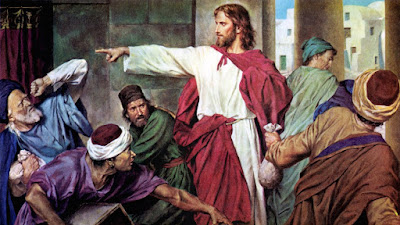
The Gospel reading gives us the scene of Jesus’s cleansing of the Temple, where He

made a whip out of cords / and drove them all out.

This story from Chapter 2 of St. John’s Gospel is the second of three parts.

In the first, Jesus shows His glory in the Wedding Feast of Cana – where the miracle is a foretaste of the Eternal Banquet to which we are all called.


The second is the cleansing of the temple, where Jesus shows His zeal – that is, His enthusiasm and dedication … His energy and motivation – for the Gospel.

And the last line of the Gospel, the third part, reminds us that

Jesus would not trust himself to them because he knew them all, / and did not need anyone to testify about human nature. / He himself understood it well.

Now that doesn’t sound very nice at first hearing. But we know that that is not the end of the story.

Rather, Jesus – being God – does know us all … and understands us well. 


And He provides us with supernatural helps – that is, the “power of God” – through grace … in the form of the Sacraments. 

He knows and understands us … but doesn’t leave us floundering without assistance.

Which, however, begs the question: Do we know and understand Him?

Knowledge can be something as flat and sterile as data … facts and information. Knowledge can be practical … a skill or practical understanding. And knowledge can be abstract … an awareness or familiarity.

But God wants us to go beyond the mere superficial knowledge.


Our Baptism has incorporated us in Christ … as members of Christ … and we should have direct experience of Christ.

This, then, through God’s revelation – in the Person of Jesus Christ, “the Word made flesh,” and through the Word proclaimed in Sacred Scripture – provides us with 

the power of God and the wisdom of God

to live out the Gospel according to the Will of God and within the Plan of God. 

And this power, wisdom, will, and plan are shown in the power of Cross of Our Lord Jesus Christ.

As we approach this altar to receive the Sacred Body and Blood, Soul and Divinity of Jesus Christ, let us pray that in our Lenten practices, we may deepen our knowledge of the Gospel and grow in holiness and virtue.

And through the power of that Cross, may we know the surpassing value of knowing Christ Jesus our Lord … above anything and everything else (cf. Phil. 3:8).