Sunday, August 22, 2021

21st Sunday in OT @ Ss. Francis and Clare, Birch Run

HOMILY - 21ST SUNDAY IN ORDINARY TIME
AUGUST 21/22, 2021


In his 1964 book Games People Play, psychologist and author Eric Berne introduced a theory examining human interactions. Based on the idea that we are all social beings, and that we relate to people on multiple levels that change depending on who we are interacting with and the circumstances we are in.

He identified three levels, calling them Parent, Adult, and Child – and depending on our role, and the role of the other person . . . Berne claimed that individuals ended up playing different subconscious roles in what he called subconscious games.


Despite his influence on modern psychology and his clinical expertise in relationships, Berne himself was married and divorced three times over the course of almost 30 years.

Nonetheless, it can be helpful to evaluate our own relationships and interactions to see if we might be playing games in certain circumstances and work towards being more sincere and straightforward in how we deal with each other and with ourselves.

Today is the 21st Sunday in Ordinary Time.

In today’s readings, we see God’s relationship with His holy people played out in various ways.


In the Old Testament reading from the end of the Book of Judges, Joshua gives the Twelve Tribes of Israel a bit of an ultimatum to make a definitive choice to serve the LORD; ending his appeal with his own firm choice, stating:

As for me and my household, we will serve the LORD.

In the Gospel, those who heard Jesus speaking on the Bread of Life – what we have been reading over the past several weeks – make the observation that:

This . . . is hard; who can accept it?

Indeed, Jesus is calling for a deep spiritual commitment ... a true conversion of heart, mind, and soul that – despite its difficulty – “gives life” . . . and not just life in this world, but rather “eternal life.

Jesus offers this new life in God . . . this eternal life . . . to all who believe. Yet despite the promise, we are also told that “many of his disciples . . . no longer accompanied him.”


St. Paul further develops this them in his letter to the Ephesians – comparing the relationship of husband and wife to Christ’s relationship with the Church . . . that is, with us. Yet in the end, he still says:

This [too] is a great mystery.

For us to truly live out the Christian life requires a solid commitment from us which very often requires difficult choices between what the world or the culture may offer us on one hand; and what the law of Christ and the Church demand of us on the other. And worldly choices may appear to offer immediate gratification – something appealing which is in fact passing and ephemeral – Jesus Christ offers us life . . . and not just life here . . . Jesus offers us eternal life.

No matter where we may find ourselves, we are called to embrace our daily situations with Christian dignity . . . abiding in Faith, Hope, and Love. While our goal is is the satisfaction of life in abundance with Christ in God’s Heavenly Kingdom – this always requires from us a personal sacrifice if we are to truly receive and engage the sanctifying gifts of grace, mercy, and love that are offered to us through our relationship with God Almighty.


As we approach this altar to receive the Sacred Body and Blood, Soul and Divinity of Jesus Christ . . . let us pray that through the mystery of the Eucharist we receive today . . . we might grow deeper in our relationship with God – Father, Son, and Holy Spirit. May the sanctifying grace of all the Sacraments we have received strengthen our commitment to God and Christ; and direct us always to follow Jesus Christ ... He who is the Way, the Truth, and the Life.

Sunday, August 15, 2021

Assumption of the BVM @ Ss. Francis and Clare Parish, Birch Run

HOMILY - ASSUMPTION OF THE BLESSED VIRGIN MARY
AUGUST 14/15, 2021

As a little kid … probably around the age of 3 or 4 … my grandmother gave me a magnifying glass. I’m not sure my mom thought it was the best idea. She was probably concerned about me breaking the lens and hurting myself or one of my siblings with the shards.

For a toddler, a magnifying glass was magic. You could see all sorts of details when you held it up close to your eye. Of course, if you held it away from your eye at a certain distance, it was a view into an upside-down world. 

I would walk around the house with it held out at an arm’s length … watching as it flipped everything around in that little loop.


Which of course meant that at one point in time … I ran into a wall with it.

The lens survived. The handle and the metal loop that held the lens are long gone. Later on in my childhood, it took it’s toll on anthills and burning my name onto leaves.I actually still have the lens stored away somewhere with childhood treasures in a closet at my folks.

Today is the Solemnity of the Assumption of the Blessed Virgin Mary.


An important holy day for a couple of reasons. One of which is that it is the patronal feast day of our diocese - the Diocese of Saginaw. It is one of the two churches that make up our parish, and it is the name of our Cathedral in Saginaw.

Secondly, it is one of the four Marian dogmas.

There is a misplaced idea in recent years that somehow anything related to Mary was stealing the show from Jesus. 

Over the past several years as a priest, I’ve worked in schools in both Michigan and California.. And I’ve yet to meet a kid who would think that if his mom were talked about in a good way that he was getting the short end of the stick.


In fact, back in the day - when life was tougher on the playground - many a fistfight was started over a comment or a joke that started or ended with “your mom.”

Nonetheless, for the record, all good theology on Mary - that is, the dogmas, the teachings, the doctrine about Our Lady - all good Mariology is based on good Christology.


And, in case you were wondering, the four Marian dogmas are:

1. Mary’s divine motherhood - which we celebrate on January 1
2. Mary’s perpetual virginity - which we hear every time we call her the “Blessed Virgin Mary.”
3. Mary’s immaculate conception - which we celebrate on December 8
4. Mary’s assumption, body and soul, into heaven at the end of her earthly life: 
    which we celebrate today.

In today’s Gospel, we hear one of the three “New Testament” hymns found in Luke’s Gospel. They are known by the first word or words in Latin, and are a part of the daily prayer of the Church. Their English titles are based on who prayed it in Luke’s Gospel. 

These are:

1. The Canticle of Zechariah
2. The Canticle of Mary
3. The Canticle of Simeon.

Today we heard the Canticle of Mary, known by it’s first Latin word: “Magnificat.”

The word “Magnificat” means “to magnify.”

In older, more literal, English translation of this verse, the first words are “My soul magnifies the Lord.”

Which begs the question: what do our souls magnify?

I would guess that at times, our souls magnify our selves, maybe sometimes our souls magnify our family, sometimes our work, maybe our friends.


Like that magnifying lens I played with as a kid, our souls are meant to be used for amazing things. And perhaps the greatest thing we can do is to magnify God with our souls, and with our hearts, and with our minds.

As we approach this altar to receive the Sacred Body and Blood, Soul and Divinity of Jesus Christ - let us pray to be a lens to the world of the grace and mercy and love of God. May our souls magnify the Lord in everything we think, in everything we say, and in everything we do.

Saturday, August 7, 2021

19th Sunday in OT @ Ss. Francis and Clare, Birch Run

HOMILY - NINETEENTH SUNDAY IN ORDINARY TIME
AUGUST 7/8, 2021

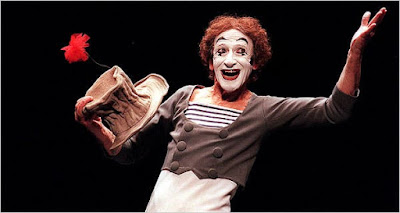
Marcel Marceau was a French actor and mime, most famous for his stage persona “Bip the Clown.” He was born into a Jewish family in 1923, and owing to the Second World War, spent a good portion of his youth in hiding. His father was deported to the Auschwitz concentration camp, and died there. Marceau and his brother Alain joined the French Resistance, and worked to save innumerable children from capture and deportation.

His mime routines, included The Cage, Walking Against the Wind, The Mask Maker, and In The Park. All of these are considered today to be classic routines.


When he was 5 years old, his mother took him to a Charlie Chaplin film, which captivated his imagination, and attracted him to mime and acting.

He called mime, The Art of Silence, explaining in a 1987 interview:

The art of silence speaks to the soul, like music, making comedy and tragedy, involving you and your life. . . . creating character and space, by making a whole show on stage - showing our lives, our dreams, our expectations.

He received world renown and held many high international honors in the arts. He died in 2007 at the age of 84.


Today is the 19th Sunday in Ordinary Time.

In St. Paul’s Letter to the Ephesians, he exhorts us to “be imitators of God,

The word St. Paul uses here that is translated “imitators” is μιμητής (mimētḗs) – which is where we get the English words mime, mimic, and mimeograph ... to name a few.

We are to imitate God, however, not just by copying Him or by mimicking Him, but rather – as St. Paul says – “as beloved children, [to] live in love, as Christ loved us and handed himself over for us as a sacrificial offering to God for a fragrant aroma.


And so the starting point, is love. And not a gushy modern melodramatic love, but rather a tough love ... a difficult love ... a sacrificial love.

In the Gospel, we continue with John chapter 6, and Jesus continues to expound on what we heard last week, where He told His listeners that He, Himself, is the Bread of Life.

This sets the people off, as they start to run through what they understood of Jesus’ background. They knew Him ... or at least they thought they knew Him.

Yet Jesus repeats Himself, restating, “I am the Bread of Life”, telling them that “whoever believes has eternal life” and whoever “eat[s] it [will] not die.


And finally today’s passage from the Gospel ends with Jesus saying one more time:

I am the living bread that came down from heaven;
whoever eats this bread will live forever;
and the bread that I will give is my flesh for the life of the world.

In the Eucharist, we receive the Body of Christ. Our “Amen” is a profession of our faith in that reality – a reality that transcends the material world.

Three characteristics of the host we receive – visible to all – give us an insight into how we are to imitate God.


The host is small. Reflecting the humility of God – not only in becoming a human being in the Person of Jesus Christ, being born in a stable, and living a relatively obscure life in a small back-water of the Roman Empire ... but also in that He still comes to us under the form of bread and wine. Because His coming is so humble, we can miss it if we are not attentive to the mystery ... the miracle before us. We are called, as well, to humble ourselves ... so that we might not miss God’s presence in our midst.

The host is round. Reflecting the eternity of God. We are called to believe in Jesus Christ, and are to call him Savior, Brother, Son of God. A living faith is our ticket to eternal life ... and so, we too are called to live with Christ in the Kingdom of God ... in eternity.

The host is white. Reflecting the purity of God. At the end of Revelation chapter 21, we are told that “nothing unclean will enter [heaven].” And so, we are called to live our lives in purity and holiness.


As we approach this altar to receive the Sacred Body and Blood, Soul and Divinity of Jesus Christ, let us pray for the grace we need to truly imitate God in all that we say and all that we do. And as we receive the Eucharist from this altar today, let us heed the words of the angel to Elijah: “eat, [or] else the journey will be too long.” And as we eat, may we remember that we are called to embrace humility, purity, and eternity – imitating God in all things, but especially in His Love.

Saturday, July 31, 2021

18th Sunday in OT @ Ss. Francis & Clare, Birch Run

HOMILY - EIGHTEENTH SUNDAY IN ORDINARY TIME
JULY 31 / AUGUST 1, 2021  


In a book on spirituality, Jesuit author J. Francis Stroud tells a story about how to catch a monkey. It goes as follows:

In India hunters have a simple but effective way to capture monkeys. They cut a hole in a coconut large enough for the monkey’s hand to go in, but small enough to hold it captive if it makes a fist. They then put a banana into the coconut and wire the coconut to a tree. The monkey puts its hand into the coconut, grabs the banana, but cannot get its hand out because it won’t open its fist and let the banana go.

Today is the 18th Sunday in Ordinary Time.


In the first reading, we hear how the Israelites “grumbled” that they had no food. The Lord sends down the miraculous rain of man’na – the word supposedly means “what is this?” in Hebrew.

In the Gospel, after Jesus challenges the people who had eaten the miraculous multiplication of loaves and fishes, they turn on Him and ask: “What sign can you do, that we may see and believe in you? What can you do?

They even recall the miraculous rain of man’na that their “ancestors ate ... in the desert.

What Jesus does tell them is that His “Father gives you the true bread from heaven” and that this bread “gives life to the world.

They immediately respond, “Sir, give us this bread always.

The crowd flips and then flops. They eat the bread Jesus miraculously multiplied, and follow Him across the sea. When Jesus challenges them, they turn on Him and demand a sign. He ignores their challenge, and instead tells tells them that His Father is the source of this bread. Then they ask for this miraculous bread always. Flip. Flop. Flip. Flop.

It may be helpful to realize that a few chapters after the scene we heard from the Old Testament in Exodus, the people who are at first impressed with the miraculous man’na ... after eating it day-in and day-out, go back to complaining – later on – about how sick they are of the man’na.

Is this some odd trait of human nature? When confronted with a miracle, there is an initial amazement, but after a while ... miracle schmear-a-cle ... and they’re on to something new. Or else get excited about a miraculous free lunch, but when challenged, make demands for more miracles.


Saint Paul provides a clue in his Letter to the Ephesians, where he exhorts us to “put away [our] old self ... and be renewed in the spirit of [our] minds.” By putting on a new self, he tells us we will be re-created “in God’s way in righteousness and holiness of truth.

Like the monkey, caught in the coconut trap, we need to be constantly reminded to put away our old self ... our old habits ... our old sins ... our old ways of thinking. We get caught in the trap of the past and it seems that under our own power we just can’t let go.


Every week, we come here to worship God. In a miraculous re- presentation of the Sacrifice of Jesus on the Cross, we are given His Body and Blood, Soul and Divinity under the form of bread and wine.

But are we trapped in worldly values and habits that prevent us from being renewed in Christ? Are we clinging to an old self or past hurts or perceived slights? Are we trapped in habitual sins that we refuse to repent of or be freed from? Are we unable to let go of all of this and allow the grace of God to re-create us in holiness and righteousness?

Do we flip ... flop ... flip ... flop between sin and virtue without any end in sight?

The answer is – Let Go and Let God. Jesus Christ is truly here ... in the Word of God ... and in the Blessed Sacrament of the Altar. We must, indeed, put away our old self, old ways, old habits, and old sins ... and allow God’s grace and mercy to renew us in Christ.

As we approach this altar to receive the Sacred Body and Blood, Soul and Divinity of Jesus Christ, let us pray for that renewal in our hearts, minds, and bodies. Let us see the miracle of grace that is here before us. Let us fix our eyes on Jesus Christ – the Bread of Life – and receive the new life that we have been promised ... in Christ Jesus our Lord.


Sunday, July 25, 2021

17th Sunday OT @ St. Cyril Bannister

HOMILY - SEVENTEENTH SUNDAY IN ORDINARY TIME
JULY 25, 2021  


Born in Washington D.C. some eighty or so years ago, Roger Kaufman is considered the “father of needs assessments.” 

A needs assessment is a systematic way of evaluating and resolving the gaps between a current situation and a desired situation. Needs assessments can be applied to individuals, classrooms, organizations, or communities. They can be used to improve products and services; as well as to clarify problems and identify appropriate solutions.

A key to a successful needs assessment is that the focus be on results and that the evidence be concrete enough to be efficient and effective.

Kaufman’s approach requires a far-reaching view … looking beyond mere products and outcomes … and even going beyond the traditional bottom line measures such as rewards or profits. These two levels he refers to as “micro” and “macro” needs … but which are, in themselves, too short-sighted.

Rather, Kaufman has developed a model for strategic planning that he calls “mega planning.” Looking beyond the output … and beyond the bottom-line … to consider “what sort of world do you want for those who come after you?” … “for your children and grandchildren?” This “ideal vision” requires thinking beyond our immediate selves and circumstances and rather consider the broader impact … or lack of impact … on society and the world at large.

Today is the Seventeenth Sunday in Ordinary Time. In today’s readings we hear how “the hand of the Lord feeds us [and] answers all our needs.” And in the Old Testament reading and Gospel, we hear of miraculous feedings … first by the Prophet Elisha – who feeds 100; and then by Our Lord, Who feeds 5,000 men … not counting the women and children.

Looking at the “micro” and “macro” levels, Elisha’s servant – in the Old Testament – and Phillip – in the Gospel protest that there is just not enough food … to feed so many people.

Yet in both cases, not only are the people fed … but there is an abundance of food – beyond what was the immediate need.

God calls us all to look beyond our perceived limitations … we are called to consider the bigger picture … the “mega” level … from God’s perspective – not from ours.

Saint Paul gives us some guidance in being able to expand our horizons. He outlines the virtues that are “worthy of the call [we] have received,” namely humility, gentleness, patience, love, unity, and peace.

Saint Paul further expands on our call in Christ … by exhorting us to be: one body, one Spirit, one hope … and to live this out through one Lord, one faith, one baptism, [and] one God and Father of all. 

All of this must be embraced, embodied, and lived – through the assistance of God’s grace. Not only on a “micro” or “macro” level … but on a “mega” level … what St. Paul calls “over all … and through all … and in all.

As we approach this altar to receive the Sacred Body and Blood, Soul and Divinity of Jesus Christ, let us pray to see ourselves and others through the eyes of God. May our vision become more and more far-reaching … so that in “one body, [and] one Spirit, [and] one hope” we may receive the graces and foundations … and the gifts and the vision … of a people united in faith and baptism … in God’s love through Christ Jesus Our Lord.

Sunday, July 4, 2021

14th Sunday OT @ St. Cyril Bannister

HOMILY - FOURTEENTH SUNDAY IN ORDINARY TIME
JULY 4, 2021  

Today is the 4th of July, the day historically held as to when the Declaration of Independence was signed in Congress. In the preamble of the Declaration, we hear:

We hold these truths to be self-evident, that all men are created equal, that they are endowed by their Creator with certain unalienable Rights, that among these are Life, Liberty and the pursuit of Happiness.

Following the French and Indian War - also known as the Seven Year War - the British Crown had begun to seek ways to recoup its military expenses from the American Colonies. The colonists, on the other hand, were opposed to taxation by the British without representation in Parliament. The British began to send troops to the colonies in order to suppress local governments ... and the rest is, as they say ... history.


In summary, that is how 236 years ago, the American Revolutionary War began.

In the First Reading, we hear how the prophet Ezekiel was sent to the Israelites whom God calls “rebels who have rebelled against me”.

In light of American history, we might wonder just what is so wrong with Israel rebelling against God? How can God not allow them their unalienable rights - most especially the pursuit of happiness?

Yet, as we heard in the Opening Prayer, our Savior Jesus Christ has “raised up a fallen world” and we - as the recipients of that gift - have been “rescued from slavery to sin”.


In other words, the rebellion of the Israelites was not against any oppression from God, but rather it was a base desire to return to “slavery to sin” - or to turn a phrase, they made a declaration of de-pendence ... on sin ... to the point of becoming slaves to sin.

In the Gospel, we hear how Jesus was received by the people of His own village as His taught in their Synagogue. While no one in the village disputed the “wisdom” or “mighty deeds” of Jesus - they were stuck on What they thought He was ... and on Who they thought He was. After all, they watched Him grow up ... knew His relatives ... knew His Mother. But despite Jesus’ power in word and in deed - the villagers could not get past their mindset that Jesus was only a carpenter ... a commoner ... no different than anyone.

Because of this - they were offended by Jesus ... and Jesus was amazed at their lack of Faith.

Which raises the questions - What does this mean for us? How do we know when we are living the Life of Faith? How do we know if we are living in the Freedom that is ours as children of God?


Again, we heard in the Opening Prayer that we have been “raised up” and “rescued” ... and in this, we should be filled with “holy joy” and receive “eternal gladness”.

And as St. Paul tells us in the Second Reading, despite any “insults, hardships, persecutions, [or] constraints” which may appear as “weaknesses” ... God’s “grace is sufficient” for us and God’s “power is made perfect in [our] weakness.”

As we approach this altar to receive the Sacred Body and Blood, Soul and Divinity - let us pray that we may embrace the Freedom we have received in Jesus Christ. May we hold onto the Truth - in the Person of Jesus Christ - and may our relationship with Him be self-evident in our lives. 

Let us tap into God’s infinite grace and mercy - which we receive through the outpouring of the Holy Spirit ... that we may be raised up to take hold of the gifts of holy joy and eternal gladness - our birthright as daughters and sons of God the Father ... redeemed and rescued by the Sacrifice and abasement of Jesus Christ ... and despite our weakness - may we be made perfect through the grace and power of the Holy Spirit.

Friday, June 18, 2021

12th Sunday OT @ St Peter Chesaning / St Cyril Bannister

HOMILY - TWELFTH SUNDAY IN ORDINARY TIME
JUNE 19/20, 2021 


Pretty much every American school kid knows that July 4, 1776 was the day the Declaration of Independence was signed in Philadelphia.

Perhaps less known is that on June 15, 1215 in Runnymede, England the Magna Carta was signed. And last week marked the 800th anniversary of that fateful day.

Prior to the signing of the Magna Carta, English monarchs were somewhat at liberty to act as they saw fit – enormous burdens through taxes and levies were common; as were arbitrary seizures of people, property, and cash by the Crown.


Enter the Magna Carta – the Great Charter of Liberties – that ensured the right to own and inherit property, and protection from excessive taxation. Things we take for granted 800 years later – such as, the consent of the governed, due process, equal protection, and separation of church and state – find their origins in the Magna Carta.

Today is the 12th Sunday in Ordinary Time.

In our reading from Job we hear a portion of God’s testimony against Job’s complaint. In this pericope, God describes His act of creation – fixing the limits of the seas and oceans, and setting up weather patterns. All the while asking Job: “Who did this?

The answer, of course, is simple: God did. The laws of nature. The boundaries of Creation. Are all according to God’s plan.

The Psalmist speaks of “the abyss,” and “the depths;” “storm[s],” winds, and “waves;” as well as how all of this is “the work . . . of the LORD.

And while this may have caused fear, “distress,” and dire “straits;” with but a word, God calms the storm and rescues those in danger.

All of this terrifying power of nature remains under God’s merciful control. As unreasonable as the universe can often appear, it remains subordinate to the jurisdiction of the Most Holy Trinity.


In the Gospel, the disciples are in boats with Jesus; when “[a] violent squall [comes] up,” and waves begin “filling up” the boat ... Jesus stills the storm with a word, and in His next sentence rebukes His disciples for their lack of Faith.

Indeed, Jesus is the Son of God ... commanding the power of nature with a word. No matter how we might view our circumstances, Jesus remains in control.

Yet are we fully convinced of this? Are we totally committed to living our lives through, with, and in Jesus Christ? When the storms of life beset us ... or perhaps more simply, when we don’t get our way ... do we cast aside faithfulness and instead pursue our own whims? Or the way of the world?


Saint Paul reminds us in the Second Letter to the Corinthians that if we have truly died with Christ, we must “live . . . no longer . . . for [ourselves] but for [Jesus]” who died and rose for us. We must allow “the old things . . . [to pass] away” and embrace the “new things [that] have come” to us through grace, mercy, and love.

As we approach this altar to receive the Sacred Body and Blood, Soul and Divinity of Jesus Christ, let us in Faith step out into the deep. Let us set aside any fears or misgivings ... and place ourselves in the hands of Our Savior. Let us remember that all Creation – ourselves included – is subject to the Laws of God and Reign of God ... and as members of Christ, we are called to be citizens of the Kingdom of God, and reign with Christ in eternity.